2018 AMC 10B Problem 7
In the figure below, congruent semicircles are drawn along a diameter of a large semicircle, with their diameters covering the diameter of the large semicircle with no overlap. Let be the combined area of the small semicircles and be the area of the region inside the large semicircle but outside the small semicircles. The ratio is . What is ?
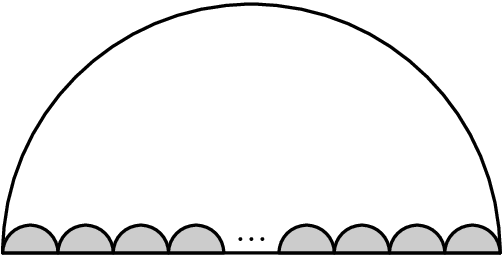
Show solution without answering
Key insight
If the big radius is N times the small one, the big semicircle holds N squared small areas, so the leftover is N squared minus N.
Solution
No lengths are given, so measure everything in "small semicircles."
1. The big radius. The small diameters lie end to end and exactly cover the big diameter. So the big diameter is times a small diameter, and the big radius is times a small radius.
2. The big area. Area grows with the square of the radius. Making the radius times as big makes the area times as big. So the big semicircle has the area of small semicircles.
3. Region . The small semicircles together make small areas.
4. Region . What is left inside the big semicircle is small areas.
5. Use the ratio. means is times :
Divide both sides by : , so .
Check with : is small areas and is small areas, and .
The answer is .
Why this works
When one shape is a scaled copy of another, lengths scale by the scale factor but areas scale by its square. That is why small semicircles fill only of the big one, and why the answer never needs an actual length.
Alternative approach
Test the choices with small radius , so a small semicircle has area . For the big radius is , so the big area is . Then and , and . It works.
Concise solution
A shorter write-up, the way contest solutions are usually written. It may take a different route from the solution above.
Let each small semicircle have radius . The small diameters, each , tile the large diameter, so the large radius is .
Combined small area: .
Large semicircle: , so the leftover region is
Therefore
Setting gives .
The answer is .
Review in the AoPS books
- Introduction to Geometry, Chapter 11: Circles
- Introduction to Algebra, Chapter 6: Ratios and Percents
- Introduction to Geometry, Chapter 12: Circles and Angles
- Introduction to Algebra, Chapter 7: Proportion (§7.1, §7.2, §7.3)
Similar problems
Problem © Mathematical Association of America (MAA), American Mathematics Competitions. Reproduced for non-commercial educational use. Solution and commentary are original to this site.