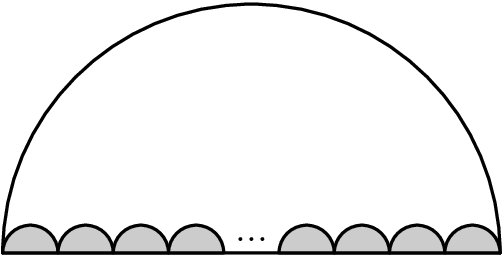
In the figure below, congruent semicircles are drawn along a diameter of a large semicircle, with their diameters covering the diameter of the large semicircle with no overlap. Let be the combined area of the small semicircles and be the area of the region inside the large semicircle but outside the small semicircles. The ratio is . What is ?
- A)
- B)
- C)
- D)
- E)
Answer
D
Key insight
With small radius r the large radius is Nr, so A:B = N : (N^2 - N) = 1 : (N-1), giving N - 1 = 18.
Solution
Let each small semicircle have radius . The small diameters, each , tile the large diameter, so the large radius is .
Combined small area: .
Large semicircle: , so the leftover region is
Therefore
Setting gives .
The answer is .
Why this works
Area scales with the square of the radius, so semicircles of radius cover only of a semicircle of radius . Everything cancels except , which is why the problem never needs an actual length. Whenever similar figures are nested, work with the ratio of a linear dimension and square it.
Alternative approach
Take and test the choices: for , and , and .
The trap
Setting A:(A+B) or A:B equal to 1:N and answering 18, or comparing radii instead of areas.
Common mistakes
- Setting A:(A+B) or A:B equal to 1:N and answering 18, or comparing radii instead of areas.
- Using the small diameter as the radius (radius each, large radius ), which still cancels correctly but invites arithmetic errors.
Techniques
Set up the equation/formula and compute; no special trick needed