2018 AMC 10A Problem 23
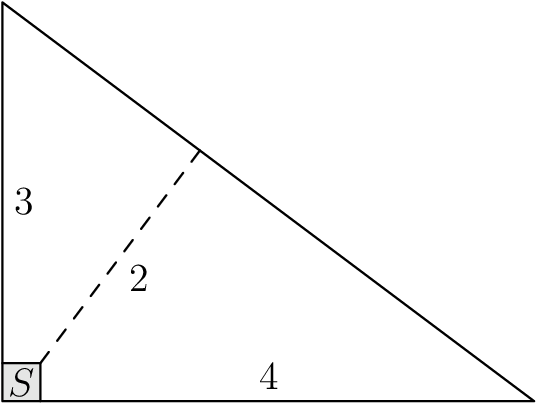
Farmer Pythagoras has a field in the shape of a right triangle. The right triangle's legs have lengths and units. In the corner where those sides meet at a right angle, he leaves a small unplanted square so that from the air it looks like the right angle symbol. The rest of the field is planted. The shortest distance from to the hypotenuse is units. What fraction of the field is planted?
Show solution without answering
Key insight
Join the square's outer corner to the far corners. The pieces are the square, a height-2 triangle on the hypotenuse, and two thin triangles.
Solution
Let the square have side , and let be the corner of the square farthest from the field's right angle. That corner is the part of the square closest to the hypotenuse, so the distance from to the hypotenuse is .
1. Area of the whole field. .
2. Cut the field into pieces. Draw lines from to the two ends of the hypotenuse. The field splits into four pieces:
- the square, area ;
- a triangle with the hypotenuse () as base and on top. Its height is the distance , so its area is ;
- a thin triangle along the side of length , with base and height , area ;
- a thin triangle along the side of length , with base and height , area .
3. The pieces add up to the field.
4. Simplify. Multiply out: . The terms cancel, leaving , so and .
5. Find the fraction. The square has area . As a fraction of the field, that is . The planted part is
The answer is .
Why this works
A "shortest distance to a side" is the height of a triangle sitting on that side. Joining the special point to the corners turns that height into an area you can compute at once, and adding all the pieces to the known total gives an equation for . This "cut into triangles from one point" trick works whenever a point inside a triangle has known distances to the sides.
Alternative approach
Coordinates. Put the right angle at with legs along the axes, so the hypotenuse is the line (it passes through and ). The square's outer corner is . The distance from a point to the line is , so
The rest is the same as above.
Concise solution
A shorter write-up, the way contest solutions are usually written. It may take a different route from the solution above.
Let the square have side and let be its corner farthest from the right angle. The nearest point of to the hypotenuse is , so the perpendicular from to the hypotenuse has length .
Cut the whole field (area ) into four pieces by drawing segments from to the two acute vertices:
- the square , area ;
- the triangle with base the hypotenuse () and apex , height , area ;
- a right triangle along the leg of length with legs and , area ;
- a right triangle along the leg of length with legs and , area .
Adding:
The terms cancel (), leaving , so .
The unplanted area is , so the planted fraction is
The answer is .
Review in the AoPS books
- Introduction to Geometry, Chapter 4: Perimeter and Area (§4.2)
- Introduction to Geometry, Chapter 17: Analytic Geometry
- Introduction to Geometry, Chapter 8: Quadrilaterals
- Introduction to Geometry, Chapter 6: Right Triangles (§6.1, §6.2, §6.3)
Similar problems
Problem © Mathematical Association of America (MAA), American Mathematics Competitions. Reproduced for non-commercial educational use. Solution and commentary are original to this site.