2014 AMC 10A Problem 23
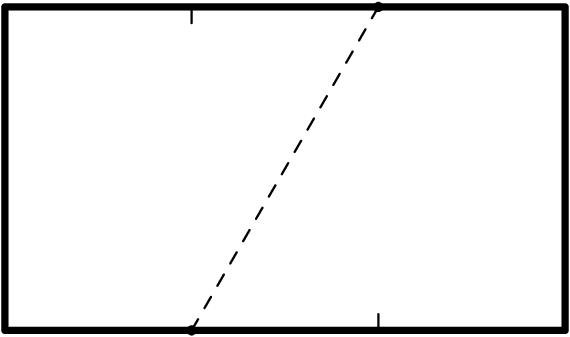
A rectangular piece of paper whose length is times the width has area . The paper is divided into three equal sections along the opposite lengths, and then a dotted line is drawn from the first divider to the second divider on the opposite side as shown. The paper is then folded flat along this dotted line to create a new shape with area . What is the ratio ?
Show solution without answering
Key insight
The fold line is tilted at 60 degrees, so the folded corner lands exactly on the opposite corner. The doubled part is an equilateral triangle, one third of the paper.
Solution
After folding, some paper lies in two layers. The new shape's area is the old area minus the part that is now covered twice. So the job is to find that doubled part.
The ratio does not depend on the size of the paper, so pick easy numbers: width and length . Then the area is .
1. Label the paper. Call the corners (bottom-left), (bottom-right), (top-right) and (top-left). Put at , so , , . Each section is wide.
2. The fold line. It goes from on the bottom (the first divider) to on the top (the second divider).
3. Some lengths. All of these come out the same, :
- .
- , the same numbers, so also .
- , read straight off the top edge.
- .
4. Triangle is equilateral, since its three sides are equal. So .
5. Where does corner land? Folding flips the right part over the line , like a mirror. The fold line rises while moving across, which is a slope, so too. is at distance from , at on one side of the fold line. Its mirror image is at the same distance and the same angle on the other side. That is exactly corner . So lands on .
6. The doubled part. The folded flap now has corners , (where went), , and the new position of , which is above the top edge. So the only part of the flap lying on top of the left part of the paper is triangle .
7. Its area. Base along the top edge, height (down to the bottom edge where is):
8. The new area. , so .
The answer is .
Why this works
Folding paper flat is a mirror flip across the crease, and it never changes the paper's total area. What the new shape loses is exactly the region where two layers sit on top of each other. Finding where a corner lands is often the fastest way to see that region. The strange-looking length is what makes the crease sit at and creates the equilateral triangle; special numbers like this usually point to special triangles.
Alternative approach
Add up the visible pieces instead of subtracting. The left part of the paper, , is exactly half the rectangle, because the crease cuts it into two matching halves; its area is . The part of the flap sticking out above the paper is triangle , where is where lands. It has base and height , so its area is . Total: .
Concise solution
A shorter write-up, the way contest solutions are usually written. It may take a different route from the solution above.
The ratio does not depend on scale, so take width and length , giving . Place the rectangle with , , , . The crease joins on the bottom edge to on the top edge.
The crease rises over a run of , so it makes a angle with the bottom edge, and
In particular triangle is equilateral, and .
Folding reflects the right flap across line . Because and the two segments make equal angles with the crease, lands exactly on . The flap's other two vertices, (fixed) and the image of , lie on or above the top edge, so the part of the folded flap that lies on the left piece is precisely triangle .
The overlap has area
Folding does not change the flap's area, so the new shape has area .
The answer is .
Review in the AoPS books
- Introduction to Geometry, Chapter 16: The More Things Change. . . (§16.1, §16.2, §16.3, §16.4)
- Introduction to Geometry, Chapter 8: Quadrilaterals
- Introduction to Geometry, Chapter 4: Perimeter and Area (§4.2)
- Introduction to Geometry, Chapter 17: Analytic Geometry (§17.4, §17.6)
Similar problems
Problem © Mathematical Association of America (MAA), American Mathematics Competitions. Reproduced for non-commercial educational use. Solution and commentary are original to this site.