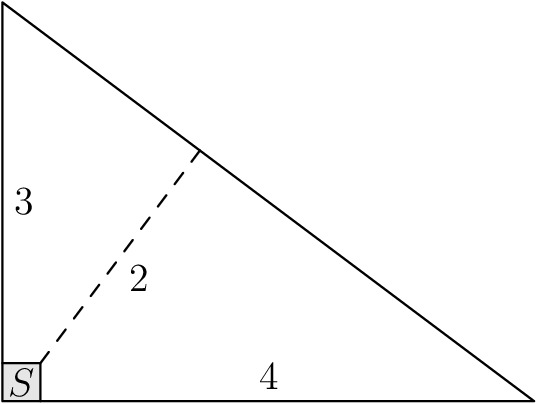
Farmer Pythagoras has a field in the shape of a right triangle. The right triangle's legs have lengths and units. In the corner where those sides meet at a right angle, he leaves a small unplanted square so that from the air it looks like the right angle symbol. The rest of the field is planted. The shortest distance from to the hypotenuse is units. What fraction of the field is planted?
- A)
- B)
- C)
- D)
- E)
Answer
D
Key insight
Cut the field into the square, a base-5 height-2 triangle on the hypotenuse, and two right triangles along the legs; total area 6 forces s = 2/7.
Solution
Let the square have side and let be its corner farthest from the right angle. The nearest point of to the hypotenuse is , so the perpendicular from to the hypotenuse has length .
Cut the whole field (area ) into four pieces by drawing segments from to the two acute vertices:
- the square , area ;
- the triangle with base the hypotenuse () and apex , height , area ;
- a right triangle along the leg of length with legs and , area ;
- a right triangle along the leg of length with legs and , area .
Adding:
The terms cancel (), leaving , so .
The unplanted area is , so the planted fraction is
The answer is .
Why this works
A "distance to a line" clue is an altitude in disguise: the segment of length is the height of a triangle whose base is the entire hypotenuse, and that triangle's area () is known instantly. Comparing the total area with the sum of the pieces converts a geometric constraint into a linear equation in . Dissection by connecting the key point to the vertices is a reusable move for any "point inside a triangle at known distance from a side" problem.
Alternative approach
Coordinates: right angle at the origin, hypotenuse on the line , corner . Distance from to the line:
Then the same fraction .
The trap
Assuming the square's far corner lies on the hypotenuse, or measuring the distance 2 from the wrong point (the right-angle vertex instead of the square's outer corner).
Common mistakes
- Assuming the square's far corner lies on the hypotenuse, or measuring the distance 2 from the wrong point (the right-angle vertex instead of the square's outer corner).
- Computing the unplanted fraction and stopping, or dividing by (the product of the legs) instead of the area .
Techniques
Place the figure on coordinates and compute · Cut the figure into known shapes (triangles, rectangles, sectors)