2016 AMC 10B Problem 19
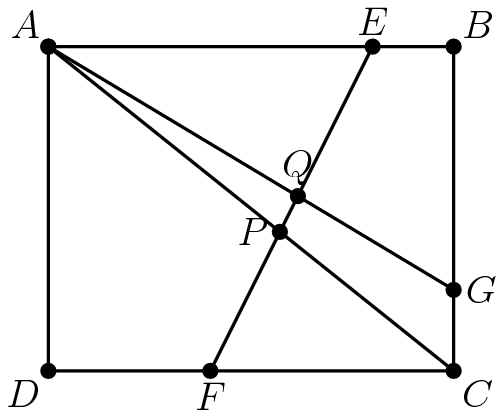
Rectangle has and . Point lies on so that , point lies on so that . and point lies on so that . Segments and intersect at and , respectively. What is the value of ?
Show solution without answering
Key insight
Put D at the origin. P and Q both lie on line EF, so PQ/EF is just the ratio of the horizontal distances: (40/13 - 20/7) divided by 2.
Solution
A rectangle with many given lengths is a good place for coordinates.
1. Put , , and .
2. is left of : . is above : . is right of : .
3. Line . From to , goes up and goes up , so the slope is . Its equation is (check: gives , gives ).
4. Line . It starts at height and drops over units, so . Where it meets :
This is point .
5. Line . It starts at height and drops over units, so . Where it meets :
This is point .
6. Compare lengths without square roots. , , , all lie on the same straight line. Along one line, lengths are in the same ratio as their horizontal widths. The width of is
and the width of is . So
The answer is .
Why this works
With a rectangle and lots of whole-number lengths, coordinates turn every point into a pair of numbers and every line into a simple equation. For points on one line, you can compare lengths using only their -coordinates, which avoids square roots completely.
Alternative approach
Measure everything as a fraction of , starting from (where ) and ending at (where ). Point is at , which is along a width of , so . Point is at , which is along, so . Then
The same fractions also come out of similar triangles without coordinates.
Concise solution
A shorter write-up, the way contest solutions are usually written. It may take a different route from the solution above.
Place , , , . Then (one unit left of ), (one unit above ), and (two units right of ).
Line through and has slope : .
Line through and : . Intersect with :
Line through and : . Intersect with :
Since , , , all lie on the same line, the ratio of lengths equals the ratio of horizontal changes:
The answer is .
Review in the AoPS books
- Introduction to Geometry, Chapter 3: Congruent Triangles
- Introduction to Geometry, Chapter 17: Analytic Geometry
- Introduction to Geometry, Chapter 5: Similar Triangles
- Introduction to Algebra, Chapter 8: Graphing Lines
Similar problems
Problem © Mathematical Association of America (MAA), American Mathematics Competitions. Reproduced for non-commercial educational use. Solution and commentary are original to this site.