2024 AMC 10A Problem 16
All of the rectangles in the figure below, which is drawn to scale, are similar to the enclosing rectangle. Each number represents the area of the rectangle. What is length ? 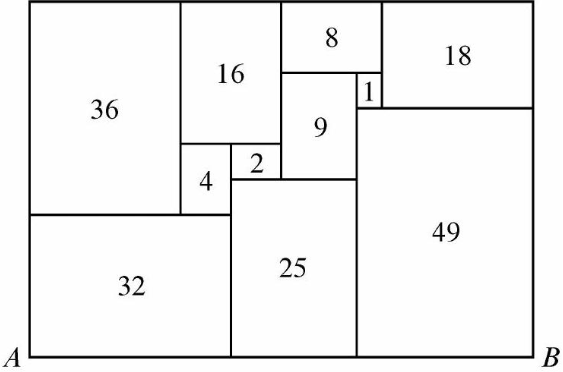
Show solution without answering
Key insight
Every rectangle has the same long-to-short ratio r. Where rectangle 8 sits exactly on top of rectangles 9 and 1, the widths must match, and that gives r = √2.
Solution
"Similar" means every rectangle has the same shape: the long side divided by the short side is the same number for all of them. Call that number . Finding is the key.
1. Sides from the area. Take a rectangle with short side . Its long side is and its area is . If the area is , then , so
For example, if were (squares), both sides would be , as you would expect.
2. Find a spot where widths must match. The figure is drawn to scale. Rectangle lies wide (longer across than up), and it sits exactly on top of rectangles and , which both stand tall. So the width of equals the width of plus the width of .
3. Write that as an equation. The width of is its long side, . The widths of and are their short sides, and . So
4. Solve for . Multiply both sides by : , so .
5. Double-check at another spot. Tall sits on top of tall and wide . Widths: . Multiply by : , so again. Good.
6. The big rectangle. Its area is the sum of all the small ones:
It lies wide, so is its long side: .
7. Match the answer form. . So .
The answer is .
Why this works
Similar shapes all share one ratio, so one unknown number describes every rectangle, and each side is the square root of the area times or divided by . Any place where one side is split exactly by two neighbours gives an equation for . Because the figure is drawn to scale, you are allowed to read off which rectangles are tall and which are wide.
Alternative approach
A rough check helps choose among the answers. The big rectangle has area and, from the picture, is about times as wide as it is tall. So is about , a bit under . The choices are about , , , and . That rules out (A), (B) and (E), but (C) and (D) are too close to separate by eye, so the exact work above is still needed.
Concise solution
A shorter write-up, the way contest solutions are usually written. It may take a different route from the solution above.
Let every rectangle have sides in the ratio (long to short), the same for all since they are similar. A rectangle of area then has short side and long side .
The figure is to scale, so orientations can be read off. Rectangle is wide (its width is its long side), while rectangles and are tall (their widths are short sides), and sits exactly on top of and . Matching widths:
Multiply through by : , so .
(Check with another spot: tall sits above tall and wide , so , i.e. , again .)
The total area is . The enclosing rectangle is wide, so its width is the long side: . Since , we get .
The answer is .
Review in the AoPS books
- Introduction to Geometry, Chapter 3: Congruent Triangles
- Introduction to Geometry, Chapter 8: Quadrilaterals
- Introduction to Geometry, Chapter 5: Similar Triangles
- Introduction to Geometry, Chapter 9: Polygons (§9.3)
Similar problems
Problem © Mathematical Association of America (MAA), American Mathematics Competitions. Reproduced for non-commercial educational use. Solution and commentary are original to this site.