Rectangle has and . Point lies on so that , point lies on so that . and point lies on so that . Segments and intersect at and , respectively. What is the value of ?
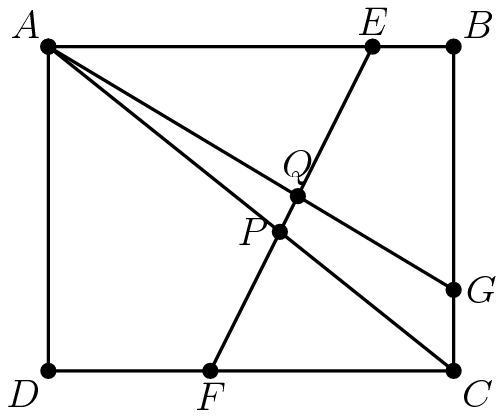
- A)
- B)
- C)
- D)
- E)
Answer
D
Key insight
Put D at the origin; P and Q lie on line EF (y = 2x - 4), so PQ/EF is just the ratio of the x-differences: (40/13 - 20/7)/2.
Solution
Place , , , . Then (one unit left of ), (one unit above ), and (two units right of ).
Line through and has slope : .
Line through and : . Intersect with :
Line through and : . Intersect with :
Since , , , all lie on the same line, the ratio of lengths equals the ratio of horizontal changes:
The answer is .
Why this works
A rectangle with lots of given lengths is an invitation to coordinates: every point has integer coordinates and every line is one equation. The finishing move is the observation that segments on a common line have lengths proportional to their -projections, so no distance formula is needed and no square roots appear, which also explains why the answer is a plain fraction.
Alternative approach
Synthetically, extend to meet line or and use similar triangles to locate and as fractions of : and , giving . The coordinate route is faster under time pressure.
The trap
Computing PQ and EF as separate square-root lengths, or placing E at distance 1 from A rather than from B.
Common mistakes
- Computing and as separate square-root lengths, or placing at distance from rather than from .
- Mixing up which intersection is (on ) and which is (on ); the ratio is unaffected, but a sign slip in can cause a wrong subtraction.
Techniques
Place the figure on coordinates and compute