2015 AMC 10A Problem 14
The diagram below shows the circular face of a clock with radius cm and a circular disk with radius cm externally tangent to the clock face at o'clock. The disk has an arrow painted on it, initially pointing in the upward vertical direction. Let the disk roll clockwise around the clock face. At what point on the clock face will the disk be tangent when the arrow is next pointing in the upward vertical direction?
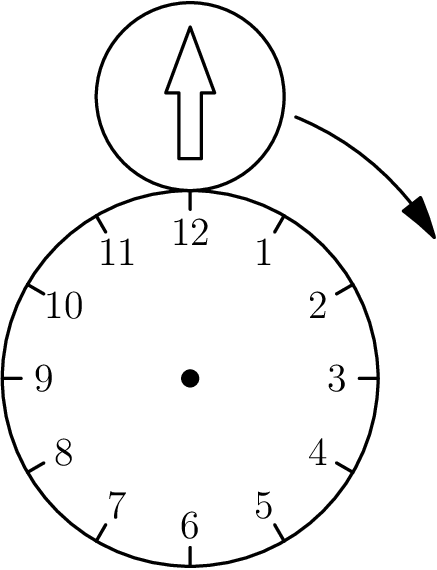
Show solution without answering
Key insight
The disk turns from rolling and also from traveling around the clock: 3 turns per lap. So the arrow is up again after one third of a lap.
Solution
Two different motions turn the arrow. Measure each one as the disk moves some angle around the clock, then add.
- Rolling. The clock's radius () is twice the disk's radius (), so the clock's edge is twice as long as the disk's edge. If the touching point moves a quarter of the way around the clock, the disk rolls along a length equal to half of its own edge. In general, the disk spins twice as much as the angle it moves around the clock, measured against the line from the clock's center to the disk's center.
- Traveling around. That line itself turns as the disk goes around. Picture the disk sliding (not rolling) around the clock with the arrow always pointing away from the clock's center: at o'clock it points right, at o'clock it points down. So traveling an angle around the clock turns the arrow by that same angle, in the same clockwise direction.
- Add them. If the disk moves an angle around the clock, the arrow turns in total.
- The arrow points straight up again after one full turn, . So and .
- Each hour on a clock face is . So is hours: clockwise from o'clock, the disk touches at o'clock.
The answer is .
Why this works
A coin rolling around the outside of another coin makes one more turn than the edge lengths alone suggest, because its center also circles around. For a disk of radius rolling around a circle of radius , the number of turns per lap is ; here . Try it with two equal coins on a table: the rolling coin turns twice, not once, in one lap.
Concise solution
A shorter write-up, the way contest solutions are usually written. It may take a different route from the solution above.
Suppose the tangent point has moved through an angle (in radians) around the clock, so the disk's center has also swung through about the clock's center. Two things rotate the arrow.
First, rolling without slipping: the disk has covered an arc of length on the clock, which is an arc of on its own circumference, so the disk has turned relative to the direction from the clock's center to the disk's center.
Second, that reference direction itself has turned through (clockwise, the same sense as the rolling).
So the arrow has rotated through in total. It next points straight up when , i.e. . Starting from o'clock and going clockwise , which is hours' worth of each, the disk is tangent at o'clock.
The answer is .
Review in the AoPS books
- Introduction to Geometry, Chapter 11: Circles
- Introduction to Geometry, Chapter 16: The More Things Change. . . (§16.1, §16.2, §16.3, §16.4)
- Introduction to Geometry, Chapter 12: Circles and Angles
- Introduction to Geometry, Chapter 13: Power of a Point
Similar problems
Problem © Mathematical Association of America (MAA), American Mathematics Competitions. Reproduced for non-commercial educational use. Solution and commentary are original to this site.