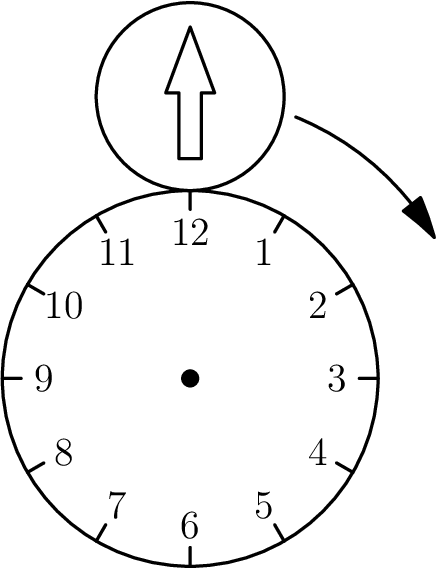
The diagram below shows the circular face of a clock with radius cm and a circular disk with radius cm externally tangent to the clock face at o'clock. The disk has an arrow painted on it, initially pointing in the upward vertical direction. Let the disk roll clockwise around the clock face. At what point on the clock face will the disk be tangent when the arrow is next pointing in the upward vertical direction?
- A)
- B)
- C)
- D)
- E)
Answer
C
Key insight
A disk rolling outside a circle of triple its radius spins 3 times per lap, so the arrow is upright again after one third of a lap: 4 o'clock.
Solution
Suppose the tangent point has moved through an angle (in radians) around the clock, so the disk's center has also swung through about the clock's center. Two things rotate the arrow.
First, rolling without slipping: the disk has covered an arc of length on the clock, which is an arc of on its own circumference, so the disk has turned relative to the direction from the clock's center to the disk's center.
Second, that reference direction itself has turned through (clockwise, the same sense as the rolling).
So the arrow has rotated through in total. It next points straight up when , i.e. . Starting from o'clock and going clockwise , which is hours' worth of each, the disk is tangent at o'clock.
The answer is .
Why this works
A disk of radius rolling around the outside of a circle of radius makes full turns per lap, not : the extra turn comes from the disk's center orbiting the fixed circle. Here turns per lap, so one turn takes a third of a lap. Whenever a rolling object also orbits, add the orbital angle to the rolling angle.
Alternative approach
Test the answer choices against the rule "the disk spins times per lap": one spin is one third of the way around, at o'clock; o'clock would be spins and o'clock only spins.
The trap
Matching arc lengths only (disk spins 20/10 = 2 times per lap) and answering 6 o'clock, forgetting that the disk's center also travels around the clock.
Common mistakes
- Matching arc lengths only (disk spins times per lap) and answering o'clock, forgetting that the disk's center also travels around the clock.
- Converting to the clock incorrectly (each hour mark is , so is four hours, not two).
Techniques
Set up the equation/formula and compute; no special trick needed