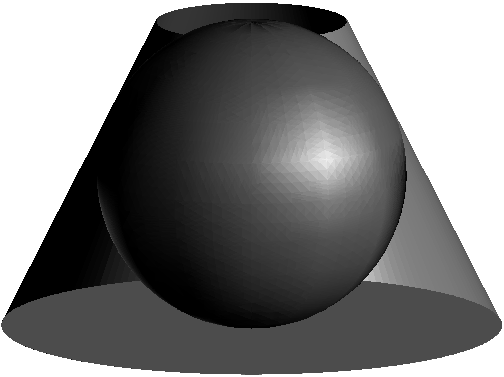
A sphere is inscribed in a truncated right circular cone as shown. The volume of the truncated cone is twice that of the sphere. What is the ratio of the radius of the bottom base of the truncated cone to the radius of the top base of the truncated cone?
- A)
- B)
- C)
- D)
- E)
Answer
E
Key insight
In the axial cross-section the incircle forces slant = R + r, hence sphere radius squared = Rr; the volume condition then becomes R^2 - 3Rr + r^2 = 0.
Solution
Let the bottom and top radii be and , and the sphere's radius . Slice through the axis: the frustum becomes an isosceles trapezoid with bases and , and the sphere becomes its incircle, so the height is .
A quadrilateral with an incircle has equal sums of opposite sides, so where is the slant side: . Dropping a perpendicular from the top base gives a right triangle with legs and and hypotenuse :
Now the volumes. Frustum: . Sphere: . The condition "frustum is twice the sphere" gives
so . Divide by and set :
Since the bottom base is larger, , so .
The answer is .
Why this works
Solids of revolution with a common axis are really plane problems: sphere in frustum is incircle in isosceles trapezoid. The tangential-quadrilateral property (equal sums of opposite sides) plus one Pythagorean step converts "inscribed" into the algebraic relation , a geometric mean. From there the problem is only about the ratio, so dividing by is the natural move.
The trap
Using the sphere's diameter as the slant height, or forgetting the middle term Rr in the frustum volume formula.
Common mistakes
- Using the sphere's diameter as the slant height, or forgetting the middle term Rr in the frustum volume formula.
- Choosing the root , or reporting (which is , the golden ratio) instead of itself.
Techniques
Apply an identity: SFFT, sum of squares, difference of cubes, Vieta · Add construction lines/points (drop altitudes, extend segments, connect centers) · Substitute to simplify (u = x+1/x, shifting, scaling)