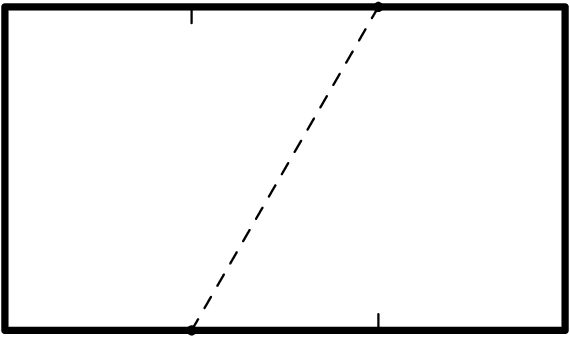
A rectangular piece of paper whose length is times the width has area . The paper is divided into three equal sections along the opposite lengths, and then a dotted line is drawn from the first divider to the second divider on the opposite side as shown. The paper is then folded flat along this dotted line to create a new shape with area . What is the ratio ?
- A)
- B)
- C)
- D)
- E)
Answer
C
Key insight
The fold line makes a 60-degree angle with the base, so corner B lands exactly on corner D and the overlap is an equilateral triangle of area A/3.
Solution
The ratio does not depend on scale, so take width and length , giving . Place the rectangle with , , , . The crease joins on the bottom edge to on the top edge.
The crease rises over a run of , so it makes a angle with the bottom edge, and
In particular triangle is equilateral, and .
Folding reflects the right flap across line . Because and the two segments make equal angles with the crease, lands exactly on . The flap's other two vertices, (fixed) and the image of , lie on or above the top edge, so the part of the folded flap that lies on the left piece is precisely triangle .
The overlap has area
Folding does not change the flap's area, so the new shape has area .
The answer is .
Why this works
A flat fold is a reflection across the crease, and the visible area afterwards is the original area minus the region covered twice. Locating where a corner lands (here ) identifies the overlap without any messy intersection computation. The special ratio is what makes the crease sit at and produces the equilateral triangle; expect such "nice" givens to create special triangles.
Alternative approach
Trace the flap directly: the reflection of across is , so the folded flap is quadrilateral , which lies above the line except for triangle . The final shape is the left piece (area ) plus triangle (area ), total .
The trap
Assuming the folded flap covers exactly half of the paper (ratio 1:2), or computing the overlap as the whole flap.
Common mistakes
- Assuming the folded flap covers exactly half of the paper (ratio 1:2), or computing the overlap as the whole flap.
- Mixing up which third-marks the crease connects (first divider on one side to second on the other), which changes the crease's angle and the overlap.
- Measuring triangle with base but the wrong height, or using side of the length instead of .
Techniques
Place the figure on coordinates and compute · Cut the figure into known shapes (triangles, rectangles, sectors)