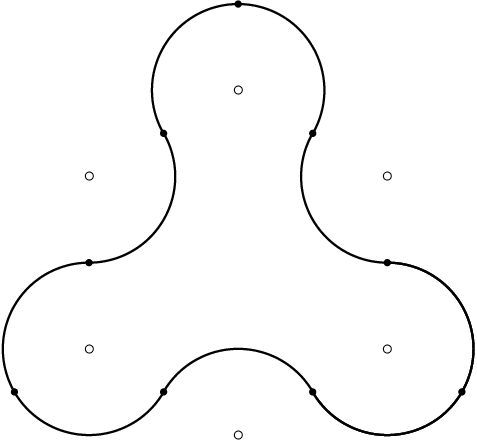
The closed curve in the figure is made up of congruent circular arcs each of length , where each of the centers of the corresponding circles is among the vertices of a regular hexagon of side . What is the area enclosed by the curve?
- A)
- B)
- C)
- D)
- E)
Answer
E
Key insight
Each arc has radius 1 and spans 120 degrees; three vertices carry 240-degree outward bulges and three carry 120-degree dents, so hexagon plus 2pi minus pi.
Solution
Read off the arcs first. Each arc is centered at a hexagon vertex and passes through the midpoints of the two sides at that vertex, so its radius is half the side, . An arc of length with radius subtends radians, i.e. .
At three alternate vertices the curve bulges outward: the two side-midpoints are joined by an arc going around the outside of the vertex. Since the hexagon's interior angle is , the outside sweep is , which is two of the nine arcs. At the other three vertices the curve dips inward through a single arc, exactly filling the interior angle. That accounts for arcs.
Now compute the area as hexagon plus bulges minus dents:
- Hexagon of side : .
- Each outward bulge is a sector of radius , lying entirely outside the hexagon: . Three of them add .
- Each inward dent removes a sector of radius : . Three of them remove .
Total: .
The answer is .
Why this works
Curves made of arcs centered at polygon vertices are handled by starting from the polygon and adjusting with sectors: bulges add a sector, dents subtract one. The angles come for free from the polygon's interior and exterior angles ( and here), and the given arc length pins down the radius. Always convert "arc length" into "radius and central angle" before touching areas.
Alternative approach
Sanity check with the answer form: the region is a hexagon-like shape of area about with net circular adjustment ; only choice (E) has the term that a side- hexagon produces.
The trap
Treating all nine arcs as bulging outward (or all inward), or using the hexagon area with side 1 instead of side 2.
Common mistakes
- Treating all nine arcs as bulging outward (or all inward), or using the hexagon area with side 1 instead of side 2.
- Using radius (the side) instead of (half the side) for the sectors, which quadruples the terms.
Techniques
Cut the figure into known shapes (triangles, rectangles, sectors) · Exploit symmetry to reduce work or pair up objects