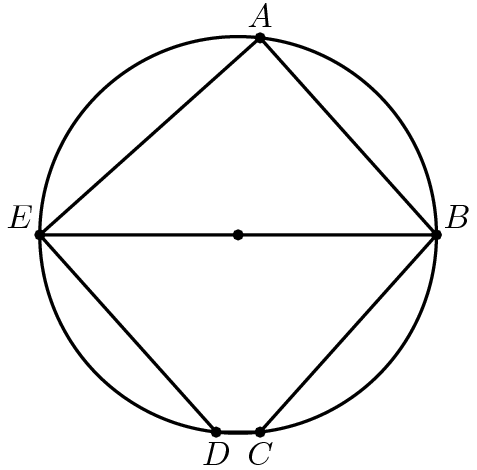
In the given circle, the diameter is parallel to , and is parallel to . The angles and are in the ratio . What is the degree measure of angle ?
- A)
- B)
- C)
- D)
- E)
Answer
C
Key insight
Angle EAB is 90 (inscribed in a semicircle), so angle ABE is 50; parallels carry it to angle BED, and cyclic quadrilateral EDCB gives angle BCD = 130.
Solution
Since is a diameter, . The other two angles of triangle sum to in ratio , so and .
Because with transversal , alternate interior angles give .
Points lie on the circle in that order (with , the chord sits on one side of the diameter and is between and along the arc). So is a cyclic quadrilateral, and its opposite angles at and are supplementary:
The answer is .
Why this works
Three standard facts chain together: Thales' theorem converts the diameter into a right angle, parallel chords transfer angles along a transversal, and a cyclic quadrilateral links an angle to its opposite. Equivalently, intercepts arc () while intercepts the rest of the circle ().
Alternative approach
is an inscribed trapezoid (), hence isosceles, so . Co-interior angles along leg then give .
The trap
Concluding angle BCD equals angle BED = 50 by 'same arc', when C lies on the arc between B and D, so the two angles are supplementary, not equal.
Common mistakes
- Concluding by "same arc", when lies on the arc between and , so the two angles are supplementary, not equal.
- Swapping the ratio and taking , which leads to .
Techniques
Set up the equation/formula and compute; no special trick needed