2010 AMC 10A Problem 2
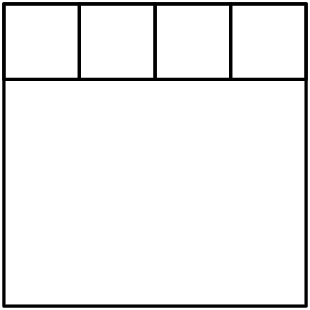
Four identical squares and one rectangle are placed together to form one large square as shown. The length of the rectangle is how many times as large as its width?
Show solution without answering
Key insight
Give the small square side 1. The big square is then 4 by 4, and the rectangle under the row is 4 long and 3 tall.
Solution
Give the small squares an easy size and read every other length off the picture.
- Say each small square has side .
- The four small squares sit side by side across the top, so the top edge of the big square is long. A square has equal sides, so the big square is by .
- The rectangle fills the rest of the big square, under the row of small squares. Its long side runs all the way across: .
- Its short side is the big square's height minus the row of small squares on top: .
- So the length is times the width.
Using side instead of gives , the same ratio, so the choice of does not matter.
The answer is .
Why this works
When a figure is built from identical pieces, give the smallest piece a size and count your way to every other length. A ratio does not depend on the actual size, so picking side is safe and makes the numbers easy.
Concise solution
A shorter write-up, the way contest solutions are usually written. It may take a different route from the solution above.
Let each small square have side . The four small squares sit in a row along the top edge, so the large square has side .
The rectangle fills everything below that row. Its length (horizontal) is the full side of the large square, . Its width (vertical) is what remains after removing the row of small squares: .
Therefore the length is times the width.
The answer is .
Review in the AoPS books
- Introduction to Geometry, Chapter 8: Quadrilaterals
- Introduction to Algebra, Chapter 6: Ratios and Percents
- Introduction to Geometry, Chapter 9: Polygons (§9.3)
- Introduction to Algebra, Chapter 7: Proportion (§7.1, §7.2, §7.3)
Similar problems
Problem © Mathematical Association of America (MAA), American Mathematics Competitions. Reproduced for non-commercial educational use. Solution and commentary are original to this site.