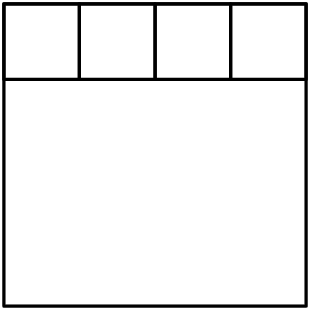
Four identical squares and one rectangle are placed together to form one large square as shown. The length of the rectangle is how many times as large as its width?
- A)
- B)
- C)
- D)
- E)
Answer
B
Key insight
Four small squares of side s span the big square's side, so the rectangle is 4s wide and 4s - s = 3s tall.
Solution
Let each small square have side . The four small squares sit in a row along the top edge, so the large square has side .
The rectangle fills everything below that row. Its length (horizontal) is the full side of the large square, . Its width (vertical) is what remains after removing the row of small squares: .
Therefore the length is times the width.
The answer is .
Why this works
Assigning one variable to the smallest repeated piece lets every other dimension be read off the figure by counting and subtracting. The ratio is independent of , which is why the problem never needs an actual measurement.
The trap
Reading the rectangle's width as the small square's side and answering 4 or 2, or inverting the ratio to 3/4.
Common mistakes
- Reading the rectangle's width as the small square's side and answering 4 or 2, or inverting the ratio to 3/4.
- Forgetting that the large figure is a square, so its height must also equal .
Techniques
Set up the equation/formula and compute; no special trick needed