2022 AMC 10B Problem 2
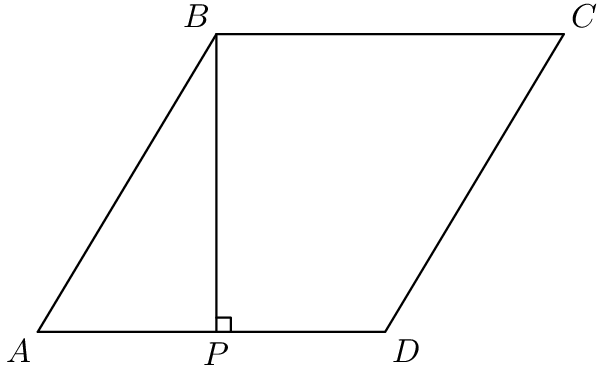
In rhombus , point lies on segment so that , , and . What is the area of ? (Note: The figure is not drawn to scale.)
Show solution without answering
Key insight
All four sides of a rhombus are equal, so AB = 5. That makes triangle ABP a 3-4-5 right triangle, and its side BP = 4 is the height.
Solution
The area of a rhombus (like any parallelogram) is base times height. The segment is perpendicular to , so it is the height when is the base. We need the lengths and .
1. The base. lies on , so .
2. Another side. All four sides of a rhombus are equal, so too.
3. The height. Triangle has a right angle at , a long side and a leg . By the Pythagorean theorem,
(This is the familiar -- right triangle.)
4. The area. Base times height is .
The answer is .
Why this works
A line dropped from a corner straight down to the opposite side is exactly the height of a parallelogram. The fact that every side of a rhombus has the same length turns the pieces and into a right triangle whose long side you already know. When a right angle appears inside a rhombus, look for a right triangle that uses one full side of the rhombus as its longest side.
Concise solution
A shorter write-up, the way contest solutions are usually written. It may take a different route from the solution above.
Since lies on , the side . A rhombus has four equal sides, so as well.
Triangle is right-angled at with hypotenuse and leg , so
A rhombus is a parallelogram, and is the height onto base . Therefore the area is .
The answer is .
Review in the AoPS books
- Introduction to Geometry, Chapter 8: Quadrilaterals
- Introduction to Geometry, Chapter 4: Perimeter and Area (§4.2)
- Introduction to Geometry, Chapter 9: Polygons (§9.3)
- Introduction to Geometry, Chapter 6: Right Triangles (§6.1, §6.2, §6.3)
Similar problems
Problem © Mathematical Association of America (MAA), American Mathematics Competitions. Reproduced for non-commercial educational use. Solution and commentary are original to this site.