2009 AMC 10B Problem 22
A cubical cake with edge length inches is iced on the sides and the top. It is cut vertically into three pieces as shown in this top view, where is the midpoint of a top edge. The piece whose top is triangle contains cubic inches of cake and square inches of icing. What is ?
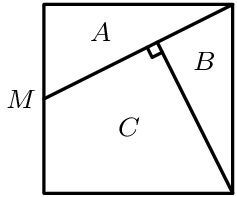
Show solution without answering
Key insight
The cuts are vertical, so the piece is triangle B stretched to height 2. Cake is twice B's area; icing is B's area plus a 2 by 2 side.
Solution
The cuts are vertical, so every piece is a straight-sided column standing on its top-view shape. Everything comes down to the area of triangle .
Step 1: set up the top view.
- Put the top of the cake on a grid with corners , , , . The midpoint is on the left edge.
- The first cut runs from the top-right corner to .
- The second cut runs from the bottom-right corner and meets the first cut at a right angle, at a point .
- Triangle is . It has a right angle at , and its long side is the right edge .
Step 2: find the area of using matching shapes.
5. Mark the point on the right edge, level with . Triangle is a right triangle (right angle at ) with legs and , so its long side is .
6. Triangles and both have a right angle, and they share the angle at (both use the right edge and the cut ). So they have the same shape. In the leg next to is and the leg across from is . Scaling the long side from up to multiplies every side by :
7. Check with the Pythagorean theorem: . Good.
8. Area of : .
Step 3: cake and icing.
- Cake: the piece is a column of height on base , so .
- Icing on top: the top of the piece is triangle , area .
- Icing on the sides: the only outside side of this piece is the face below edge , a square with area . The other two sides are cut faces, and cut faces have no icing.
- So .
- Total: .
The answer is .
Why this works
Vertical cuts turn a 3-D question into a 2-D one: volume is the top-view area times the height, and side icing is the outer edge length times the height. The only real work is one flat area, and a right triangle that shares an angle with a simple -- triangle gives it quickly.
Alternative approach
Find as a height instead. Triangle has base on the right edge and its third corner is away from that edge, so its area is . Using as the base instead, the height is (because meets at a right angle), so and . Then , and the area of is again .
Concise solution
A shorter write-up, the way contest solutions are usually written. It may take a different route from the solution above.
Put the top face on coordinates with corners and . The first cut runs from the corner to ; the second runs from the corner perpendicular to that cut, meeting it at a point . Triangle is , the piece against the right edge .
Find . The line has direction and length . The distance from to that line is the height of triangle (base ): its area is , so the height is . In right triangle with hypotenuse and leg , the other leg is . Hence
Because the cuts are vertical, the piece is a prism of height on base : .
Icing: the top of the piece (area ) and the one outer side face along edge , a square of area . The two cut faces are bare. So .
Therefore .
The answer is .
Review in the AoPS books
- Introduction to Geometry, Chapter 14: Three-Dimensional Geometry
- Introduction to Geometry, Chapter 3: Congruent Triangles
- Introduction to Geometry, Chapter 17: Analytic Geometry
- Introduction to Geometry, Chapter 4: Perimeter and Area (§4.2, §4.3)
Similar problems
Problem © Mathematical Association of America (MAA), American Mathematics Competitions. Reproduced for non-commercial educational use. Solution and commentary are original to this site.