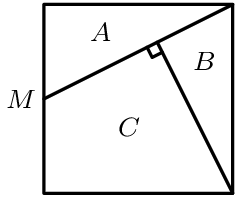
A cubical cake with edge length inches is iced on the sides and the top. It is cut vertically into three pieces as shown in this top view, where is the midpoint of a top edge. The piece whose top is triangle contains cubic inches of cake and square inches of icing. What is ?
- A)
- B)
- C)
- D)
- E)
Answer
B
Key insight
Vertical cuts make the piece a prism, so everything reduces to triangle B's area 4/5; volume is twice that and icing is that plus the full 2-by-2 side face.
Solution
Put the top face on coordinates with corners and . The first cut runs from the corner to ; the second runs from the corner perpendicular to that cut, meeting it at a point . Triangle is , the piece against the right edge .
Find . The line has direction and length . The distance from to that line is the height of triangle (base ): its area is , so the height is . In right triangle with hypotenuse and leg , the other leg is . Hence
Because the cuts are vertical, the piece is a prism of height on base : .
Icing: the top of the piece (area ) and the one outer side face along edge , a square of area . The two cut faces are bare. So .
Therefore .
The answer is .
Why this works
Vertical cuts through a box create prisms, so a 3-D question collapses onto the top view: volume is base area times height, and side icing is edge length times height. The only real work is one planar area, found here through the altitude of a triangle with a known area.
Alternative approach
Triangles and , where is the top-left corner, are similar right triangles (they share the angle at ). Triangle has legs and , hypotenuse ; scaling to hypotenuse gives legs and and area immediately.
The trap
Icing the cut faces, or forgetting that the piece has an entire outer side face of area 4 iced in addition to its top.
Common mistakes
- Icing the cut faces, or forgetting that the piece has an entire outer side face of area 4 iced in addition to its top.
- Reporting alone, (choice A), instead of .
Techniques
Place the figure on coordinates and compute · Cut the figure into known shapes (triangles, rectangles, sectors)