2009 AMC 10A Problem 6
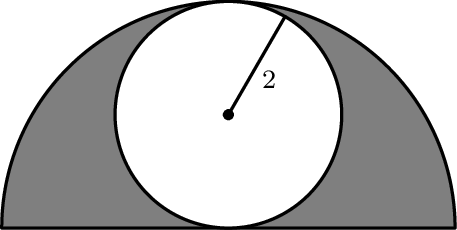
A circle of radius is inscribed in a semicircle, as shown. The area inside the semicircle but outside the circle is shaded. What fraction of the semicircle's area is shaded?
Show solution without answering
Key insight
The small circle reaches from the middle of the flat edge up to the top of the arc, so the semicircle's radius is the small circle's diameter, 4.
Solution
- Look at the picture. The small circle sits on the flat edge of the semicircle, touching it at its middle point, which is the center of the semicircle. It also touches the curved arc at the very top.
- So the small circle's diameter goes straight from the semicircle's center up to its arc. That distance is the semicircle's radius. The small circle has diameter , so the semicircle has radius .
- Area of the semicircle: half of , which is .
- Area of the small circle: .
- Shaded area: .
- Fraction shaded: .
The answer is .
Why this works
The only real work is reading the picture: find one length that belongs to both shapes (here, the line from the semicircle's center to the top of the arc) and write it in terms of each shape. After that it is two area formulas and a subtraction.
Concise solution
A shorter write-up, the way contest solutions are usually written. It may take a different route from the solution above.
The small circle touches the semicircle's diameter at the center of the semicircle and touches the arc at the top. So the small circle's diameter, , runs from the center of the semicircle straight up to the arc; that distance is the semicircle's radius. Hence the semicircle has radius .
Semicircle area: .
Circle area: .
Shaded area: , which is of the semicircle.
The answer is .
Review in the AoPS books
- Introduction to Geometry, Chapter 11: Circles
- Introduction to Geometry, Chapter 12: Circles and Angles
- Introduction to Geometry, Chapter 13: Power of a Point
Similar problems
Problem © Mathematical Association of America (MAA), American Mathematics Competitions. Reproduced for non-commercial educational use. Solution and commentary are original to this site.