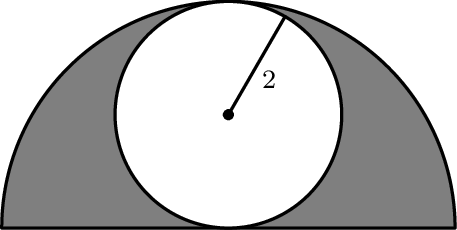
A circle of radius is inscribed in a semicircle, as shown. The area inside the semicircle but outside the circle is shaded. What fraction of the semicircle's area is shaded?
- A)
- B)
- C)
- D)
- E)
Answer
A
Key insight
The inscribed circle's diameter equals the semicircle's radius, so the semicircle has radius 4 and area 8 pi, exactly twice the circle's 4 pi.
Solution
The small circle touches the semicircle's diameter at the center of the semicircle and touches the arc at the top. So the small circle's diameter, , runs from the center of the semicircle straight up to the arc; that distance is the semicircle's radius. Hence the semicircle has radius .
Semicircle area: .
Circle area: .
Shaded area: , which is of the semicircle.
The answer is .
Why this works
The only real step is reading the figure correctly: a circle inscribed in a semicircle has its diameter along the semicircle's radius. After that it is two area formulas and a subtraction. Whenever a figure shows nested circles, locate the segment that both shapes share (here, center to top of arc) and express it two ways.
The trap
Giving the semicircle radius 2 as well, or using a full circle of radius 4 (area 16 pi) and answering 1/4 or 3/4.
Common mistakes
- Giving the semicircle radius 2 as well, or using a full circle of radius 4 (area 16 pi) and answering 1/4 or 3/4.
- Reporting the shaded area or the ratio of circle to semicircle instead of the requested fraction.
Techniques
Set up the equation/formula and compute; no special trick needed