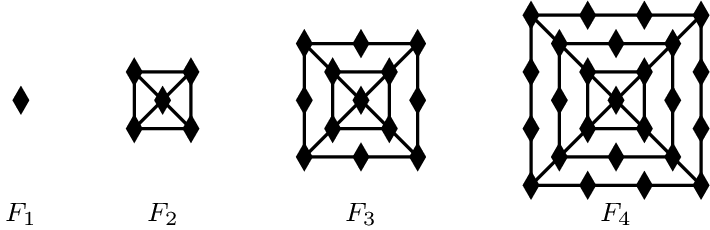
The figures , , , and shown are the first in a sequence of figures. For , is constructed from by surrounding it with a square and placing one more diamond on each side of the new square than had on each side of its outside square. For example, figure has diamonds. How many diamonds are there in figure ?
- A)
- B)
- C)
- D)
- E)
Answer
E
Key insight
Each new outer square adds 4(n-1) diamonds, so F_n = 1 + 4(1 + 2 + ... + (n-1)) = 2n(n-1) + 1, and F_20 = 761.
Solution
Count the diamonds in the first figures: , , , . The increases are .
Why: the outer square of has diamonds on each side, and a square with diamonds per side contains diamonds (four corners are shared). So
Summing the increments from :
Check: and , matching the figure.
Then .
The answer is .
Why this works
A figure built by adding a layer each step is a sequence with a computable difference; when the differences grow linearly (), the total is quadratic and a partial sum of an arithmetic series gives the closed form. Always test the formula on the values the problem hands you before evaluating at .
Alternative approach
: the diamonds form a diagonal grid consisting of an array interleaved with an array (the centered square numbers ). Then .
The trap
Guessing a formula like n^2 (giving 400) from too few terms instead of verifying against 1, 5, 13, 25 and the stated F_3 = 13.
Common mistakes
- Guessing a formula like n^2 (giving 400) from too few terms instead of verifying against 1, 5, 13, 25 and the stated F_3 = 13.
- Counting diamonds on the new square (double-counting the corners), which gives and a wrong total.
Techniques
Compute small cases, spot the pattern, generalize