2009 AMC 10A Problem 12
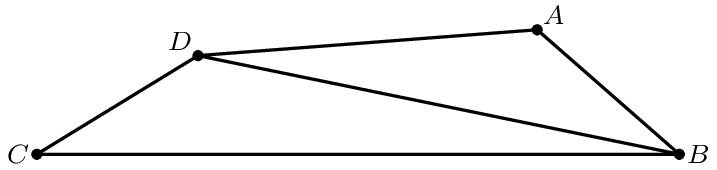
In quadrilateral , , , , , and is an integer. What is ?
Show solution without answering
Key insight
In triangle BCD, BD + 5 must be more than 17, so BD > 12. In triangle ABD, BD < 5 + 9 = 14. So BD = 13.
Solution
The diagonal splits the shape into two triangles. In any triangle, the two shorter sides together must be longer than the third side. Use this in both triangles.
1. Triangle has sides , and . The side is long, so the other two together must beat it:
2. Triangle has sides , and . Here must be less than the other two together:
3. So is more than and less than . The only whole number that fits is .
4. Check both triangles with : and . Both are real triangles.
The answer is .
Why this works
A side shared by two triangles gets limits from both. A lower limit comes from the triangle with a long side that the shared side must help cover ( must be more than ), and an upper limit from the other triangle ( must be less than ). Squeezing a whole number between the two limits is a common AMC pattern.
Concise solution
A shorter write-up, the way contest solutions are usually written. It may take a different route from the solution above.
The diagonal is a side of two triangles, and each gives a triangle inequality.
In with sides , and : the longest side must be less than the sum of the other two, so , giving .
In with sides , and : .
So , and the only integer in that range is . (Both triangles then exist: and .)
The answer is .
Review in the AoPS books
- Introduction to Geometry, Chapter 4: Perimeter and Area (§4.2)
- Introduction to Geometry, Chapter 6: Right Triangles (§6.1, §6.2, §6.3)
- Introduction to Geometry, Chapter 10: Geometric Inequalities (§10.3)
Similar problems
Problem © Mathematical Association of America (MAA), American Mathematics Competitions. Reproduced for non-commercial educational use. Solution and commentary are original to this site.