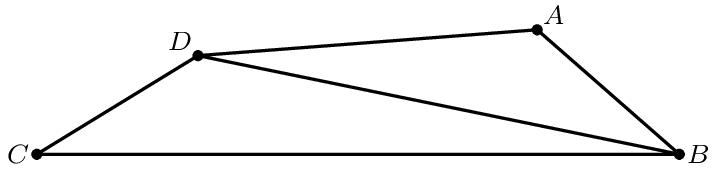
In quadrilateral , , , , , and is an integer. What is ?
- A)
- B)
- C)
- D)
- E)
Answer
C
Key insight
Triangle BCD forces BD > 17 - 5 = 12 and triangle ABD forces BD < 5 + 9 = 14, so the integer BD is 13.
Solution
The diagonal is a side of two triangles, and each gives a triangle inequality.
In with sides , and : the longest side must be less than the sum of the other two, so , giving .
In with sides , and : .
So , and the only integer in that range is . (Both triangles then exist: and .)
The answer is .
Why this works
A shared side of two triangles inherits bounds from both. The lower bound comes from the triangle where is not the longest side ( must exceed the difference of the other two), and the upper bound from the triangle where it could be the longest. Pairing a "difference" bound with a "sum" bound is the standard way to pin down an integer length.
The trap
Using only upper bounds (BD < 22, BD < 14) and guessing among 11, 12, 13, missing the lower bound BD > 12 from triangle BCD.
Common mistakes
- Using only upper bounds (BD < 22, BD < 14) and guessing among 11, 12, 13, missing the lower bound BD > 12 from triangle BCD.
- Applying the triangle inequality to the whole quadrilateral (e.g. only), which is far too weak.
Techniques
Bound the quantity above/below or estimate to pin it down