2007 AMC 10B Problem 19
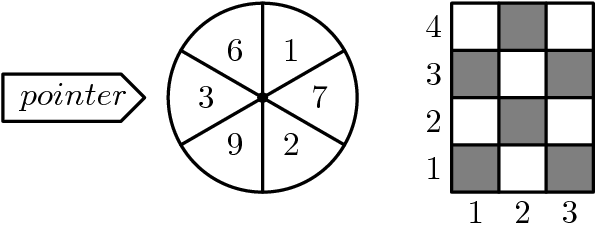
The wheel shown is spun twice, and the randomly determined numbers opposite the pointer are recorded. The first number is divided by and the second number is divided by The first remainder designates a column, and the second remainder designates a row on the checkerboard shown. What is the probability that the pair of numbers designates a shaded square?
Show solution without answering
Key insight
In every column the shaded squares are rows 1 and 3, or rows 2 and 4, and each of those row pairs comes up exactly half the time.
Solution
The wheel has six equal parts: . The board has columns and rows . Reading the picture:
- In columns and , the shaded squares are in rows and .
- In column , the shaded squares are in rows and .
Step 1: the column (first spin, divide by 4).
| number | 1 | 2 | 3 | 6 | 7 | 9 |
|---|---|---|---|---|---|---|
| remainder | 1 | 2 | 3 | 2 | 3 | 1 |
Each column shows up times out of .
Step 2: the row (second spin, divide by 5).
| number | 1 | 2 | 3 | 6 | 7 | 9 |
|---|---|---|---|---|---|---|
| remainder | 1 | 2 | 3 | 1 | 2 | 4 |
So row comes up times out of , row also , row once, row once.
Step 3: combine.
- If the column is or , we need row or row . That happens times out of , a chance of .
- If the column is , we need row or row . That happens times out of , again .
- So no matter which column comes up, the chance of a shaded square is . The overall probability is .
The answer is .
Why this works
The two spins do not affect each other, so you can look at one column at a time and ask how likely the shaded rows in it are. The rows are not equally likely, but the checkerboard pairs a common row with an uncommon row ( with , with ), and each pair covers exactly half the wheel. That is why the column never matters.
Alternative approach
List all equally likely pairs of spins by counting. Columns and come from of the first-spin numbers, and each needs one of good second-spin numbers: pairs. Column comes from first-spin numbers, again with good second-spin numbers: pairs. That is good pairs out of , which is .
Concise solution
A shorter write-up, the way contest solutions are usually written. It may take a different route from the solution above.
The wheel has six equal sectors labeled . The board has columns and rows , shaded like a checkerboard with square shaded: in columns and the shaded rows are and ; in column they are and .
Column (first spin, remainder mod ): the numbers give remainders , so each column has probability .
Row (second spin, remainder mod ): the remainders are , so
Now combine. If the column is or , a shaded square needs row or : probability . If the column is , it needs row or : probability . In every column the chance of landing on a shaded square is , so the overall probability is .
The answer is .
Review in the AoPS books
- Introduction to Counting & Probability, Chapter 7: Introduction to Probability
- Introduction to Number Theory, Chapter 12: Introduction to Modular Arithmetic
- Introduction to Algebra, Chapter 22: Special Manipulations (§22.3)
- Introduction to Counting & Probability, Chapter 8: Basic Probability Techniques
Similar problems
Problem © Mathematical Association of America (MAA), American Mathematics Competitions. Reproduced for non-commercial educational use. Solution and commentary are original to this site.