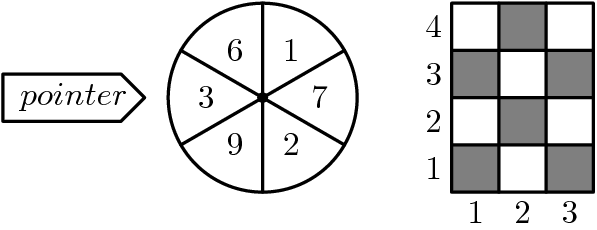
The wheel shown is spun twice, and the randomly determined numbers opposite the pointer are recorded. The first number is divided by and the second number is divided by The first remainder designates a column, and the second remainder designates a row on the checkerboard shown. What is the probability that the pair of numbers designates a shaded square?
- A)
- B)
- C)
- D)
- E)
Answer
C
Key insight
Whatever column is chosen, the shaded rows in it are either {1,3} or {2,4}, and each of those row-sets has probability exactly 1/2.
Solution
The wheel has six equal sectors labeled . The board has columns and rows , shaded like a checkerboard with square shaded: in columns and the shaded rows are and ; in column they are and .
Column (first spin, remainder mod ): the numbers give remainders , so each column has probability .
Row (second spin, remainder mod ): the remainders are , so
Now combine. If the column is or , a shaded square needs row or : probability . If the column is , it needs row or : probability . In every column the chance of landing on a shaded square is , so the overall probability is .
The answer is .
Why this works
The two spins are independent, so condition on the column and add the probabilities of the shaded rows in that column. The row distribution is not uniform, but the checkerboard pairs rows against and both pairs happen to carry probability , so the column never matters.
The trap
Assuming the rows are equally likely (1/4 each); the remainders mod 5 of 1, 2, 3, 6, 7, 9 favor rows 1 and 2.
Common mistakes
- Assuming the rows are equally likely (1/4 each); the remainders mod 5 of 1, 2, 3, 6, 7, 9 favor rows 1 and 2.
- Forgetting that a remainder of is impossible here (no wheel number is a multiple of or ) and inventing a fourth column or fifth row.
Techniques
Set up the equation/formula and compute; no special trick needed · Exploit symmetry to reduce work or pair up objects