2007 AMC 10A Problem 19
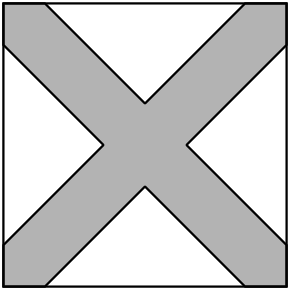
A paint brush is swept along both diagonals of a square to produce the symmetric painted area, as shown. Half the area of the square is painted. What is the ratio of the side length of the square to the brush width?
Show solution without answering
Key insight
Measure the unpainted half: four equal right triangles against the sides. What remains of each side is two short painted pieces set by the brush width.
Solution
Let the side of the square be and the brush width . Every edge of paint runs parallel to a diagonal, so it meets the sides of the square at . That means every piece of the picture is a right triangle with two equal legs.
1. Look at the unpainted part. It is four identical triangles, one against the middle of each side. Each is a right triangle with two equal legs, and its long side lies along a side of the square.
2. Size of one unpainted triangle. Half the square is unpainted, so each triangle has area . A right triangle with equal legs has area , so and . Its long side is .
3. Painted part of one side. The rest of that side is painted:
It is made of two equal pieces, one at each corner.
4. One corner piece. At a corner the brush stripe runs along the diagonal. Its two edges are from the diagonal. An edge meets the side at , so it hits the side from the corner. That is the painted piece.
5. Set up the equation. Two corner pieces fill the painted part of the side:
6. Solve for the ratio. Divide both sides by : . So
The answer is .
Why this works
Everything in this figure is built from angles, so each piece is a right triangle with equal legs, and one length tells you the others. The unpainted part is four neat triangles, which is much simpler to measure than the painted cross. When a shape is hard to describe, try measuring what is left over instead.
Alternative approach
Let and measure the paint directly. One stripe along a diagonal is a strip of length and width , minus two small triangles that stick out past the corners, each of area . So one stripe has area . The two stripes overlap in a square in the middle, so
Solving this (the smaller solution, since the brush is narrow) gives , so .
Concise solution
A shorter write-up, the way contest solutions are usually written. It may take a different route from the solution above.
Let the square have side and the brush width . Each painted strip has edges parallel to a diagonal, so every edge meets the sides of the square at .
Work with the unpainted part first. It consists of four congruent isosceles right triangles, one against the middle of each side, with total area . Each has area , so its legs are and its hypotenuse, which lies along a side of the square, is .
The rest of that side, of length , is painted and is split evenly between the two corners. At a corner the painted region is a small isosceles right triangle whose hypotenuse, perpendicular to the diagonal, is the brush width ; so its leg along the side is . Two such legs fill the painted part of the side:
Therefore
The answer is .
Review in the AoPS books
- Introduction to Geometry, Chapter 8: Quadrilaterals
- Introduction to Geometry, Chapter 4: Perimeter and Area (§4.2)
- Introduction to Algebra, Chapter 22: Special Manipulations (§22.3)
- Introduction to Geometry, Chapter 9: Polygons (§9.3)
Similar problems
Problem © Mathematical Association of America (MAA), American Mathematics Competitions. Reproduced for non-commercial educational use. Solution and commentary are original to this site.