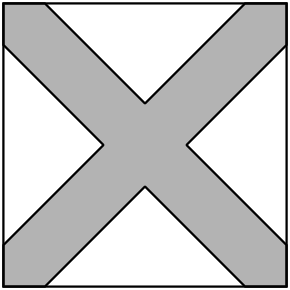
A paint brush is swept along both diagonals of a square to produce the symmetric painted area, as shown. Half the area of the square is painted. What is the ratio of the side length of the square to the brush width?
- A)
- B)
- C)
- D)
- E)
Answer
C
Key insight
The unpainted half is four isosceles right triangles, each with hypotenuse s/sqrt(2) along a side; the leftover painted edge is two corner legs of length w/sqrt(2).
Solution
Let the square have side and the brush width . Each painted strip has edges parallel to a diagonal, so every edge meets the sides of the square at .
Work with the unpainted part first. It consists of four congruent isosceles right triangles, one against the middle of each side, with total area . Each has area , so its legs are and its hypotenuse, which lies along a side of the square, is .
The rest of that side, of length , is painted and is split evenly between the two corners. At a corner the painted region is a small isosceles right triangle whose hypotenuse, perpendicular to the diagonal, is the brush width ; so its leg along the side is . Two such legs fill the painted part of the side:
Therefore
The answer is .
Why this works
Everything in the figure is built from angles, so each region is an isosceles right triangle or a square, and one length determines all the others. Using the unpainted half (four clean triangles) is far simpler than measuring the painted cross directly, and "half the area" then fixes the triangle size. Look for the simpler complement whenever a figure is described by what it is not.
Alternative approach
Set and compute the painted area directly: each strip is a rectangle of length and width minus two corner triangles, area ; the two strips overlap in a square. So , whose smaller root is , giving .
The trap
Treating the brush width as the length of painted edge at each corner; the painted edge piece is w/sqrt(2), the leg of a 45-degree triangle with hypotenuse w.
Common mistakes
- Treating the brush width as the length of painted edge at each corner; the painted edge piece is , the leg of a -degree triangle with hypotenuse .
- Adding the two strips' areas without subtracting their overlapping central square, which shifts the equation and the root.
Techniques
Cut the figure into known shapes (triangles, rectangles, sectors) · Exploit symmetry to reduce work or pair up objects