2019 AMC 10B Problem 20
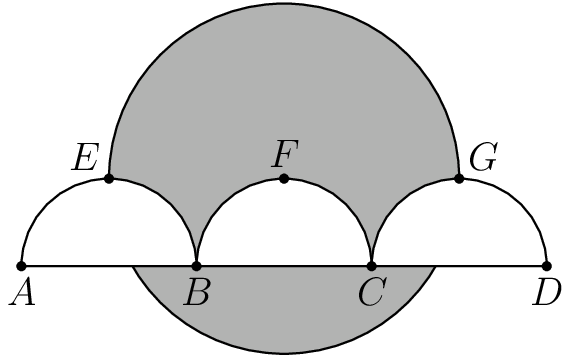
As shown in the figure, line segment is trisected by points and so that Three semicircles of radius and have their diameters on lie in the same halfplane determined by line , and are tangent to line at and respectively. A circle of radius has its center on The area of the region inside the circle but outside the three semicircles, shaded in the figure, can be expressed in the form where and are positive integers and and are relatively prime. What is ?
Show solution without answering
Key insight
Cut the big circle along lines EG and AD. Above EG is a half-disk, below AD is a circle slice, and in between only two small gaps are shaded.
Solution
The figure already contains two useful straight lines: the tangent line and the diameter line . Cut the big circle along both and handle each part separately.
Set up coordinates with at . The semicircles have radius and touch line , so is the line and is the line . The semicircle centers (the midpoints of , , ) are , , , so and . The big circle has center and radius .
Part 1: above line . The semicircles all stay below , so the whole top half of the big circle is shaded. Area: .
Part 2: between and .
- In this strip the semicircles cover almost everything. What is left inside the big circle are two curved gaps, one between each pair of neighboring semicircles.
- The left gap sits inside the rectangle with corners , , , . That rectangle is by , area .
- The two semicircles each cover a quarter-circle of radius inside that rectangle, total .
- So one gap has area , and two gaps have area .
- The parts of the outer semicircles beyond and (where is past or ) are outside the big circle anyway, so nothing else in this strip is shaded.
Part 3: below line . This is the slice of the big circle cut off by the chord along .
- The chord is unit from the center, and the radius is . So its endpoints are at , and the chord has length .
- Each half of the triangle from the center to the chord has sides , , : a -- triangle. So the angle at the center is .
- The pie slice with a angle has area .
- Remove the triangle (base , height , area ). The slice below the chord has area .
Total.
So , , , , and .
The answer is .
Why this works
A strange shaded region becomes easy when you cut it along lines the figure already gives you. Above one line and below the other, the pieces are standard shapes: a half-circle and a circle slice (pie slice minus triangle). Only the middle strip needs care, and there the leftovers are "rectangle minus two quarter-circles."
Concise solution
A shorter write-up, the way contest solutions are usually written. It may take a different route from the solution above.
Place at the origin, so line is , line is , and the semicircle centers are . Cut the big disk into three horizontal zones.
Above . The semicircles lie below (touching it at ), so the whole upper half-disk is shaded: area .
Between and . Here the semicircles cover everything except the two gaps between neighbors, plus points beyond the outer semicircles; those have and are outside the big circle. Each gap sits in the rectangle with corners , and the two adjacent semicircle centers, minus two quarter-disks of radius : area . The gaps lie inside the big circle (their outer arcs run from or , on the circle, inward to or at distance ). Two gaps: .
Below . The chord along is at distance from the center of a radius- circle, so it subtends a central angle (half-angle with ). The segment below it has area
Total.
So , , , , and .
The answer is .
Review in the AoPS books
- Introduction to Geometry, Chapter 11: Circles
- Introduction to Geometry, Chapter 8: Quadrilaterals
- Introduction to Geometry, Chapter 4: Perimeter and Area (§4.2, §4.3)
- Introduction to Geometry, Chapter 19: Problem Solving Strategies in Geometry (§19.1)
Similar problems
Problem © Mathematical Association of America (MAA), American Mathematics Competitions. Reproduced for non-commercial educational use. Solution and commentary are original to this site.