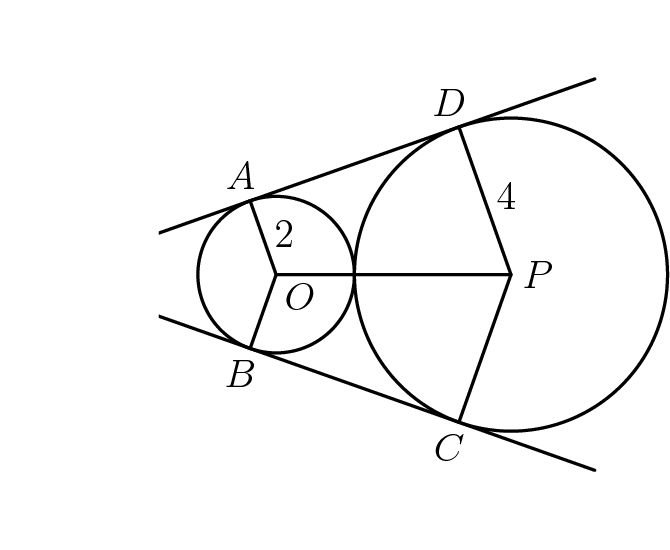
Circles with centers and have radii and , respectively, and are externally tangent. Points and on the circle with center and points and on the circle with center are such that and are common external tangents to the circles. What is the area of the concave hexagon ?
- A)
- B)
- C)
- D)
- E)
Answer
B
Key insight
Radii to tangent points are perpendicular to the tangent, so OADP is a right trapezoid with bases 2 and 4 and height 4*sqrt(2).
Solution
The line is an axis of symmetry of the whole figure, so the hexagon is two congruent copies of quadrilateral ; find that area and double it.
Because is tangent to both circles, and . Thus and is a right trapezoid with parallel sides and and height .
To get , drop a perpendicular from to , meeting it at . Then is a rectangle, so and , while since the circles are externally tangent. In right triangle ,
Trapezoid area: . The hexagon has area .
The answer is .
Why this works
Two standard moves carry the problem: radii to points of tangency are perpendicular to the tangent (turning the figure into right trapezoids), and the length of a common external tangent comes from the right triangle whose hypotenuse joins the centers and whose short leg is the difference of the radii. Symmetry across the line of centers means only half the figure needs computing.
Alternative approach
Extend past to meet the tangent lines at . Similar triangles with ratio give , , so and . Kite has area and kite has area ; the hexagon is their difference, .
The trap
Using the center distance 6 as the tangent length AD, or assuming the tangent segment equals the sum of the radii, which gives 36.
Common mistakes
- Using the center distance 6 as the tangent length AD, or assuming the tangent segment equals the sum of the radii, which gives 36.
- Treating as a rectangle or a parallelogram (parallel sides are and , not equal), or forgetting to double the half-figure.
Techniques
Add construction lines/points (drop altitudes, extend segments, connect centers) · Cut the figure into known shapes (triangles, rectangles, sectors) · Exploit symmetry to reduce work or pair up objects