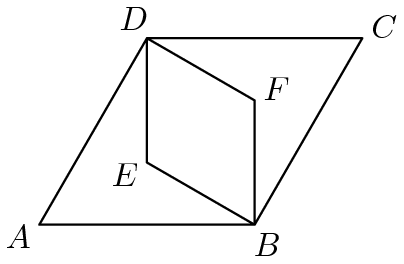
Rhombus is similar to rhombus . The area of rhombus is and . What is the area of rhombus ?
- A)
- B)
- C)
- D)
- E)
Answer
C
Key insight
Diagonal BD is the short diagonal of ABCD but the long diagonal of BFDE, so the similarity ratio is 1/sqrt3 and the area ratio 1/3.
Solution
Let the side of be . Since and , triangle is equilateral, and so is triangle . Hence the short diagonal is , and the long diagonal is twice the altitude of an equilateral triangle: .
Now look at rhombus . Its angles are also and (it is similar to ). In the figure and sit close to segment , so the angles at and are the obtuse ones and the angles at and are . The diagonal joining the two acute vertices of a rhombus is the longer one, so is the long diagonal of .
Matching long diagonal to long diagonal, the similarity ratio is
so the areas are in ratio . The area of is .
The answer is .
Why this works
A rhombus is two equilateral triangles glued along the short diagonal, which fixes the diagonal ratio with no coordinates. Similar figures have areas in the square of any pair of corresponding lengths; the only care needed is to identify which diagonal of the small rhombus corresponds to which of the large one.
Alternative approach
Triangle is isosceles with apex angle on base , so its apex is the center of equilateral triangle and . Likewise , so .
The trap
Comparing BD with itself or with a side, instead of matching corresponding diagonals (long to long) of the two similar rhombi.
Common mistakes
- Comparing BD with itself or with a side, instead of matching corresponding diagonals (long to long) of the two similar rhombi.
- Using the ratio directly on the area (answer , not offered) instead of squaring it.
Techniques
Cut the figure into known shapes (triangles, rectangles, sectors) · Exploit symmetry to reduce work or pair up objects