Rolly wishes to secure his dog with an 8-foot rope to a square shed that is 16 feet on each side. His preliminary drawings are shown.
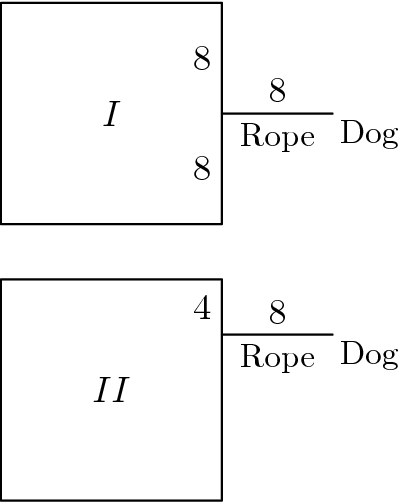
Which of these arrangements give the dog the greater area to roam, and by how many square feet?
- A)
- B)
- C)
- D)
- E)
Answer
C
Key insight
Both setups give a half-disk of radius 8; in II the rope also bends around the nearby corner with 4 feet to spare, adding a quarter-disk of radius 4.
Solution
In arrangement I the rope is tied to the midpoint of a -foot side, feet from each corner. The dog can sweep a half-disk of radius on the outside of that wall:
The rope exactly reaches each corner with nothing left over, so no further region is added.
In arrangement II the tie point is feet from one corner and feet from the other. The same half-disk of radius is available (the wall blocks the other half exactly as before), giving . But now the rope reaches the near corner with feet to spare, and bending around that corner it sweeps a quarter-disk of radius along the adjacent wall:
On the far side, , so the rope never reaches that corner.
Arrangement II gives , exceeding arrangement I by .
The answer is .
Why this works
Tethered-animal regions decompose into sectors: a large sector where the rope swings freely, then a smaller sector each time the rope bends around a corner, with radius equal to the leftover rope. Only the differences between the two arrangements need computing, and the only difference here is the single corner wrap.
The trap
Giving arrangement I an extra region too, or making the wrap-around piece in II a quarter-disk of radius 8 (adding 16π) instead of radius 8 − 4 = 4.
Common mistakes
- Giving arrangement I an extra region too, or making the wrap-around piece in II a quarter-disk of radius (adding ) instead of radius .
- Thinking the half-disk in II is smaller because the tie point is off-center; the wall is a straight line, so the half-disk is unchanged.
Techniques
Cut the figure into known shapes (triangles, rectangles, sectors)