2005 AMC 10A Problem 19
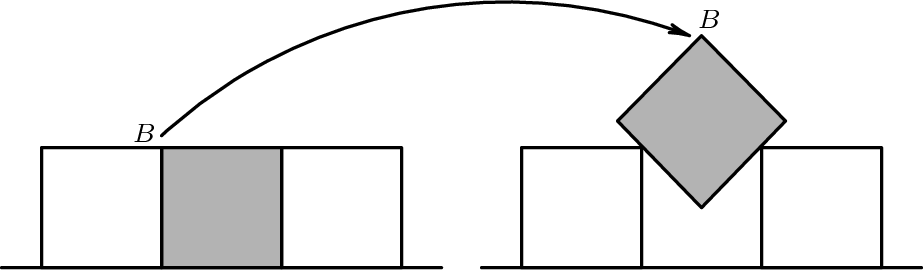
Three one-inch squares are placed with their bases on a line. The center square is lifted out and rotated , as shown. Then it is centered and lowered into its original location until it touches both of the adjoining squares. How many inches is the point from the line on which the bases of the original squares were placed?
Show solution without answering
Key insight
The tilted square rests on its neighbors' inner top corners, at height 1. Its bottom tip is half an inch lower, and B is one diagonal above the tip.
Solution
After a turn, the middle square stands on one corner. Its diagonal, from the bottom tip straight up to , has length (the diagonal of a by square). So we only need the height of the bottom tip.
1. Where does it touch? The gap between the outer squares is inch wide. As the tilted square is lowered, its two lower edges slope outward at . They hit the inner top corners of the neighboring squares. Those two corners are inch apart and inch above the base line.
2. Draw a small triangle. Join the two touching corners to each other and to the bottom tip. The two slanted sides lie along the tilted square's edges, which meet at a right angle at the bottom tip. So this is a right triangle with two equal legs, with the inch segment across the top as its longest side.
3. How far below the corners is the tip? In a -- triangle, the height from the right angle to the longest side is half that side. Half of is . So the tip is inch below the corners, at height .
4. Go up to . is one full diagonal above the tip:
The answer is .
Why this works
A square turned is easiest to measure along its diagonals, and its edges make angles with the ground. Any flat line across it therefore forms a -- triangle with the lower tip. Find the exact touching points first, then add up the heights in steps: ground to corners, down to the tip, up to .
Alternative approach
Use coordinates. Put the middle of the gap at and let the bottom tip be at height . The lower edges go up one unit for every unit sideways, so the right edge reaches height at . The neighbor's corner is at , so and . Then is at height .
Concise solution
A shorter write-up, the way contest solutions are usually written. It may take a different route from the solution above.
After the turn, the middle square's diagonals are vertical and horizontal; is its top vertex and the diagonal from down to the bottom vertex has length .
The gap between the two outer squares is inch wide and inch tall. As the tilted square descends, its two lower edges (each sloping at ) first touch the outer squares at their inner top corners, which are inch apart at height above the base line.
Connect those two corners to the bottom vertex of the tilted square. This is an isosceles right triangle with hypotenuse (the horizontal segment between the corners) and right angle at the bottom vertex, so its height is half the hypotenuse, . The bottom vertex therefore sits inch below the corners, at height .
Finally, is a full diagonal above the bottom vertex:
The answer is .
Review in the AoPS books
- Introduction to Geometry, Chapter 4: Perimeter and Area (§4.2)
- Introduction to Geometry, Chapter 16: The More Things Change. . . (§16.1, §16.2, §16.3, §16.4)
- Introduction to Geometry, Chapter 19: Problem Solving Strategies in Geometry (§19.1)
- Introduction to Geometry, Chapter 6: Right Triangles (§6.1, §6.2, §6.3)
Similar problems
Problem © Mathematical Association of America (MAA), American Mathematics Competitions. Reproduced for non-commercial educational use. Solution and commentary are original to this site.