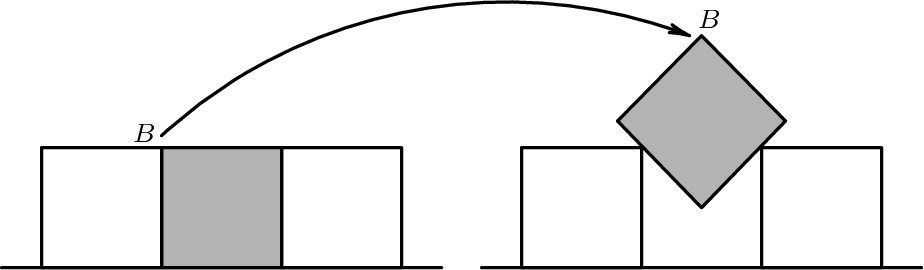
Three one-inch squares are placed with their bases on a line. The center square is lifted out and rotated , as shown. Then it is centered and lowered into its original location until it touches both of the adjoining squares. How many inches is the point from the line on which the bases of the original squares were placed?
- A)
- B)
- C)
- D)
- E)
Answer
D
Key insight
The tilted square stops when its lower edges hit the neighbors' top corners, 1 inch apart; a 45-45-90 triangle puts its bottom vertex 1/2 below those corners.
Solution
After the turn, the middle square's diagonals are vertical and horizontal; is its top vertex and the diagonal from down to the bottom vertex has length .
The gap between the two outer squares is inch wide and inch tall. As the tilted square descends, its two lower edges (each sloping at ) first touch the outer squares at their inner top corners, which are inch apart at height above the base line.
Connect those two corners to the bottom vertex of the tilted square. This is an isosceles right triangle with hypotenuse (the horizontal segment between the corners) and right angle at the bottom vertex, so its height is half the hypotenuse, . The bottom vertex therefore sits inch below the corners, at height .
Finally, is a full diagonal above the bottom vertex:
The answer is .
Why this works
A square rotated is best measured along its diagonals, and its edges make angles with the horizontal, so any horizontal chord across it is the hypotenuse of a -- triangle. Identify the exact contact points (the corners), then chain vertical distances: base to corners, corners down to the vertex, vertex up to .
Alternative approach
Coordinates: put the bottom vertex at ; the lower edges are . The outer squares' corners lie on these edges when , and .
The trap
Assuming the tilted square's bottom vertex rests on the base line, giving B at height root 2, or forgetting to add the neighbors' height 1.
Common mistakes
- Assuming the tilted square's bottom vertex rests on the base line, giving B at height root 2, or forgetting to add the neighbors' height 1.
- Using the side length instead of the diagonal for the vertical extent of the tilted square, giving .
Techniques
Add construction lines/points (drop altitudes, extend segments, connect centers)