2014 AMC 10B Problem 13
Six regular hexagons surround a regular hexagon of side length as shown. What is the area of ?
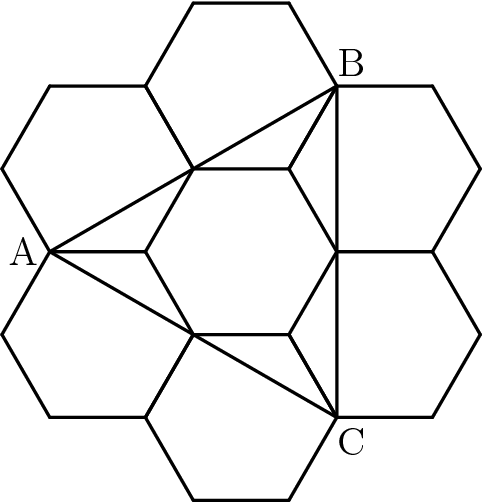
Show solution without answering
Key insight
Measure from the center of the middle hexagon: each corner of triangle ABC is 2 units away, and the three corners are evenly spaced, so the triangle is equilateral.
Solution
The whole picture is built around the center of the middle hexagon, so measure everything from there. Call that center .
- Put in coordinates. Place at with the middle hexagon's corners at , , , , , . (A regular hexagon of side is six equilateral triangles of side meeting at the center, so each corner is from .)
- Where are , , ? Each of them is a corner where two outer hexagons meet, sitting straight out from a corner of the middle hexagon. Two outer hexagons share an edge of length that starts at a corner of the middle hexagon and points straight away from . So each of , , is from , in the same direction as a corner of the middle hexagon.
- Using every other corner, as in the figure: , , . (Each is twice a corner of the middle hexagon.)
- Area. and lie on the vertical line , so take as the base: its length is .
- The height is the horizontal distance from to that line: from to is .
- Area .
The answer is .
Why this works
In a picture made of regular hexagons, the center of the middle one is the natural place to measure from, and every length is a whole number or a whole number times . Once you know how far each corner of the triangle is from the center, the triangle is fixed. Choosing a base that lies on a vertical line makes the height easy to read off.
Alternative approach
Skip coordinates. The three corners , , are each from and spaced evenly around it, apart, so is equilateral. Drop a perpendicular from to side : it makes a -- triangle with hypotenuse , so half of is and . The area of an equilateral triangle with side is .
Concise solution
A shorter write-up, the way contest solutions are usually written. It may take a different route from the solution above.
Let be the center of the middle hexagon. Draw , , .
Look at vertex . The ray from through a vertex of the central hexagon reaches after distance (a regular hexagon's circumradius equals its side). Beyond , two outer hexagons meet along a common edge that lies on the same ray by symmetry, and is the far end of that edge. So . Likewise .
The three rays are spaced apart, so is equilateral with circumradius . Dropping the perpendicular from to gives a -- triangle with hypotenuse , so half of is and .
The area is
The answer is .
Review in the AoPS books
- Introduction to Geometry, Chapter 4: Perimeter and Area (§4.2)
- Introduction to Geometry, Chapter 8: Quadrilaterals
- Introduction to Geometry, Chapter 19: Problem Solving Strategies in Geometry (§19.1)
- Introduction to Algebra, Chapter 22: Special Manipulations (§22.3)
Similar problems
Problem © Mathematical Association of America (MAA), American Mathematics Competitions. Reproduced for non-commercial educational use. Solution and commentary are original to this site.