2005 AMC 10A Problem 12
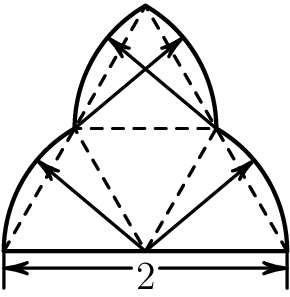
The figure shown is called a trefoil and is constructed by drawing circular sectors about sides of the congruent equilateral triangles. What is the area of a trefoil whose horizontal base has length ?
Show solution without answering
Key insight
Each bulge is a sector minus a small triangle, and the four small triangles fill the big one. So the trefoil is just four 60 degree sectors.
Solution
The dashed lines split a big equilateral triangle with side into four small equilateral triangles with side . Each curved edge of the trefoil is a arc of radius drawn across a side of one small triangle.
1. Break the shape up. The trefoil is the big triangle plus four curved bulges, one outside each arc's straight edge.
2. What is one bulge? Take a slice of a circle of radius (a sector). Its straight part is a small equilateral triangle with side . The bulge is the sector with that triangle removed:
3. Add everything up.
4. Watch the triangles cancel. The big triangle is made of exactly four small triangles. So "big triangle" and " small triangle" are equal and cancel out:
5. Area of one sector. is of a full turn, so one sector has area .
6. Total. .
The answer is .
Why this works
Curved shapes built on a triangle grid are best written as sectors plus or minus triangles. Here each sector covers one small grid triangle plus one bulge, and there are exactly as many sectors as small triangles, so the whole trefoil is just four sectors. Before computing terms, check whether they cancel.
Alternative approach
Estimate. The big triangle has area , and the trefoil is that plus four thin bulges, so it should be a bit bigger than . Now estimate the choices: (B) is about ; (C), (D) and (E) are all above ; (A) is about . Each bulge is , so four of them add about , giving about . That matches (B).
Concise solution
A shorter write-up, the way contest solutions are usually written. It may take a different route from the solution above.
The dashed lines show a large equilateral triangle of side split into four equilateral triangles of side . Each of the four curved arcs is a arc of radius drawn on a side of one of the small triangles, so the trefoil equals the big triangle plus four circular segments.
Each segment is a sector of radius minus a side- equilateral triangle. Therefore
But the big triangle is made of exactly four small triangles, so the triangle terms cancel and only the sectors remain:
The answer is .
Review in the AoPS books
- Introduction to Geometry, Chapter 11: Circles
- Introduction to Geometry, Chapter 4: Perimeter and Area (§4.2)
- Introduction to Algebra, Chapter 22: Special Manipulations (§22.3)
- Introduction to Geometry, Chapter 12: Circles and Angles
Similar problems
Problem © Mathematical Association of America (MAA), American Mathematics Competitions. Reproduced for non-commercial educational use. Solution and commentary are original to this site.