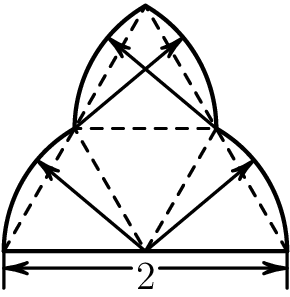
The figure shown is called a trefoil and is constructed by drawing circular sectors about sides of the congruent equilateral triangles. What is the area of a trefoil whose horizontal base has length ?
- A)
- B)
- C)
- D)
- E)
Answer
B
Key insight
The trefoil is four 60-degree sectors of radius 1 rearranged: each sector is one small equilateral triangle plus one circular segment.
Solution
The dashed lines show a large equilateral triangle of side split into four equilateral triangles of side . Each of the four curved arcs is a arc of radius drawn on a side of one of the small triangles, so the trefoil equals the big triangle plus four circular segments.
Each segment is a sector of radius minus a side- equilateral triangle. Therefore
But the big triangle is made of exactly four small triangles, so the triangle terms cancel and only the sectors remain:
The answer is .
Why this works
Curvy regions on a triangular grid are best written as sectors plus or minus triangles, then simplified. Here the four bulges each add a segment (sector minus triangle), and the four subtracted triangles are exactly the pieces of the base triangle, so the whole area is four sectors. The cancellation is not luck: each sector's straight part is one grid triangle, and there are four of each.
Alternative approach
Reject choices with a term by estimation: the trefoil looks only slightly larger than a triangle of area , and fits, while choices (C)-(E) exceed and (A) is about , which would correspond to only two sectors plus a triangle.
The trap
Adding the four circular segments to the full side-2 triangle without noticing that the four small triangles they subtract cancel it exactly, leaving a stray root-3 term.
Common mistakes
- Adding the four circular segments to the full side-2 triangle without noticing that the four small triangles they subtract cancel it exactly, leaving a stray root-3 term.
- Using radius for the sectors (the base length) instead of radius (the small triangle's side).
Techniques
Cut the figure into known shapes (triangles, rectangles, sectors) · Exploit symmetry to reduce work or pair up objects