2004 AMC 10B Problem 25
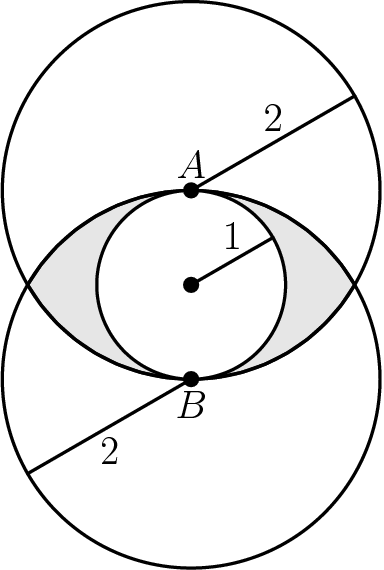
A circle of radius is internally tangent to two circles of radius at points and , where is a diameter of the smaller circle. What is the area of the region, shaded in the picture, that is outside the smaller circle and inside each of the two larger circles?
Show solution without answering
Key insight
Find the overlap of the two big circles, then remove the small circle. The overlap is two 120-degree slices, each minus a triangle.
Solution
The shaded region is awkward because of the hole. So fill the hole first: find the whole overlap of the two big circles, then subtract the small circle (area ).
1. Where are the big centers? The big circle that touches the small one at has radius and its center lies on the line through the small circle's center, units from . That is exactly , the other end of the diameter. Likewise the other big circle is centered at . So we have two circles of radius centered at and , with .
2. The crossing points. Let and be where the two big circles cross. is on both circles, so and . With , triangle has all sides : it is equilateral. The same holds for .
3. The angle at . and , so .
4. Split the overlap. The straight line cuts the football-shaped overlap into two equal halves. The half nearer is part of the circle centered at : it is the slice with triangle removed.
- Slice: is of the circle, so its area is .
- Triangle : the line crosses at its middle, from , so the height from is . The length is twice the height of an equilateral triangle of side , which is . Area .
- One half of the overlap: .
5. Whole overlap: .
6. Take out the small circle:
The answer is .
Why this works
A region between arcs is built from pieces of the form "slice of a circle minus a triangle." Drawing lines from the crossing points to the centers shows the angles; equal radii and center distance make equilateral triangles, so the angles are and and shows up. When a region has a hole, find the region without the hole first and subtract the hole at the end.
Alternative approach
If time is short, use the choices. Choices (C), (D), (E) are each exactly more than (A) or (B), so they match forgetting to remove the small circle. The angles here are and , which bring , not . That leaves (B).
Concise solution
A shorter write-up, the way contest solutions are usually written. It may take a different route from the solution above.
From the figure, the two large circles are centered at and , with (a diameter of the unit circle). The unit circle lies entirely inside the overlap of the two large disks, touching its boundary only at and . So the shaded area is
Let and be the two points where the large circles cross. Since , triangle is equilateral, and likewise . Thus at center the chord spans an angle .
The chord splits the lens into two congruent circular segments. The segment on circle 's side is the sector minus triangle :
- sector: ;
- triangle : its base has length (twice the altitude of an equilateral triangle of side ) and its height from is (half of ), so its area is .
Each segment is , so the lens is . Removing the unit disk of area :
The answer is .
Review in the AoPS books
- Introduction to Geometry, Chapter 11: Circles
- Introduction to Geometry, Chapter 4: Perimeter and Area (§4.2)
- Introduction to Geometry, Chapter 19: Problem Solving Strategies in Geometry (§19.1)
- Introduction to Geometry, Chapter 12: Circles and Angles
Similar problems
Problem © Mathematical Association of America (MAA), American Mathematics Competitions. Reproduced for non-commercial educational use. Solution and commentary are original to this site.