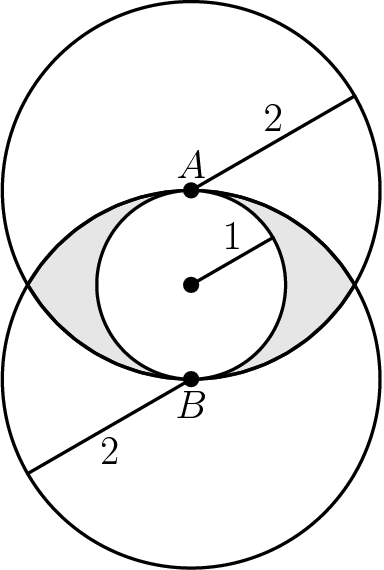
A circle of radius is internally tangent to two circles of radius at points and , where is a diameter of the smaller circle. What is the area of the region, shaded in the picture, that is outside the smaller circle and inside each of the two larger circles?
- A)
- B)
- C)
- D)
- E)
Answer
B
Key insight
The shaded region is the lens where the two big disks overlap minus the unit disk; the lens is two 120-degree circular segments, each 4pi/3 - sqrt(3).
Solution
From the figure, the two large circles are centered at and , with (a diameter of the unit circle). The unit circle lies entirely inside the overlap of the two large disks, touching its boundary only at and . So the shaded area is
Let and be the two points where the large circles cross. Since , triangle is equilateral, and likewise . Thus at center the chord spans an angle .
The chord splits the lens into two congruent circular segments. The segment on circle 's side is the sector minus triangle :
- sector: ;
- triangle : its base has length (twice the altitude of an equilateral triangle of side ) and its height from is (half of ), so its area is .
Each segment is , so the lens is . Removing the unit disk of area :
The answer is .
Why this works
Overlaps of circles are built from circular segments, and a segment is always "sector minus triangle." Joining the intersection points to the centers exposes the key angles; here the equal radii and center distance make equilateral triangles, so every angle is or and every length involves . Decompose first, subtract the excluded piece last.
Alternative approach
Answer-choice reasoning under time pressure: choices (C), (D), (E) each exceed a choice from (A), (B) by exactly , the area of the unit disk, so they are the "forgot to subtract" traps. Angles of and generate , never , which leaves (B).
The trap
Forgetting to remove the unit disk (giving 8pi/3 - 2sqrt(3), choice (E)), or double-counting the equilateral triangles when adding sectors.
Common mistakes
- Forgetting to remove the unit disk (giving 8pi/3 - 2sqrt(3), choice (E)), or double-counting the equilateral triangles when adding sectors.
- Using a sector instead of for each segment, which halves the term.
Techniques
Add construction lines/points (drop altitudes, extend segments, connect centers) · Cut the figure into known shapes (triangles, rectangles, sectors)