2004 AMC 10A Problem 23
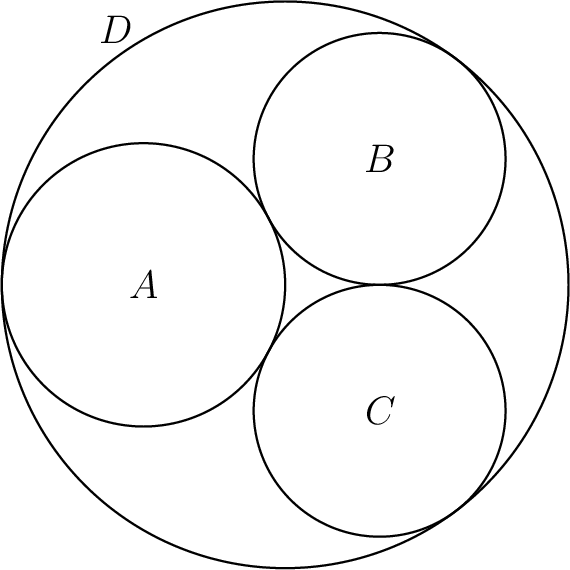
Circles and are externally tangent to each other, and internally tangent to circle . Circles and are congruent. Circle has radius and passes through the center of . What is the radius of circle ?
Show solution without answering
Key insight
Circle D has radius 2. Put B's center at (x, r); touching D and touching A give two distance equations, leading to r = 8/9.
Solution
Two circles that touch from the outside have centers (sum of radii) apart. If one circle touches another from the inside, the centers are (difference of radii) apart. Everything below uses just these two facts.
1. Radius of . Circle touches from the inside and also passes through 's center. So a full diameter of , which is , stretches from 's center to 's edge. Circle has radius .
2. Coordinates. Put 's center at and 's center at . Circles and are the same size and sit symmetrically above and below the horizontal line, so call 's center , where is the radius we want. ('s center is then , exactly from , so and touch automatically.)
3. touches from the inside, so :
4. touches from the outside, so :
5. Put step 3 into step 4: , so and .
6. Put this back into step 3:
7. The radius is not , so divide by : and .
8. Check: , and . It fits.
The answer is .
Why this works
Touching circles are completely described by their centers and radii: from the outside, the centers are the sum of the radii apart; from the inside, the difference. Putting the coordinates along the line of symmetry leaves two unknowns and two distance equations, and subtracting one from the other removes the squared terms.
Alternative approach
There is a known formula, Descartes' circle theorem, for four circles that all touch each other. Using "bending" , with the outer circle counted as negative: for , for , and for each of and . The theorem says (sum of bendings) (sum of squared bendings):
Multiplying out gives , so and . This is quick if you know the formula, but it is outside the usual school toolkit.
Concise solution
A shorter write-up, the way contest solutions are usually written. It may take a different route from the solution above.
Circle is internally tangent to and passes through 's center, so a diameter of lies along a radius of : circle has radius .
Place 's center at the origin and 's center at . By the symmetry of and , their centers are and , where is the unknown radius; the two circles then touch each other automatically, since their centers are apart.
Two tangency conditions remain.
Circle inside : , so
Circle touching externally: , so
Substitute the first into the second: , giving . Then
Since , . (Then , consistent with .)
The answer is .
Review in the AoPS books
- Introduction to Geometry, Chapter 11: Circles
- Introduction to Geometry, Chapter 4: Perimeter and Area (§4.2)
- Introduction to Geometry, Chapter 17: Analytic Geometry (§17.4, §17.6)
- Introduction to Geometry, Chapter 19: Problem Solving Strategies in Geometry (§19.1)
Similar problems
Problem © Mathematical Association of America (MAA), American Mathematics Competitions. Reproduced for non-commercial educational use. Solution and commentary are original to this site. Also appeared as 2004 12A #19.