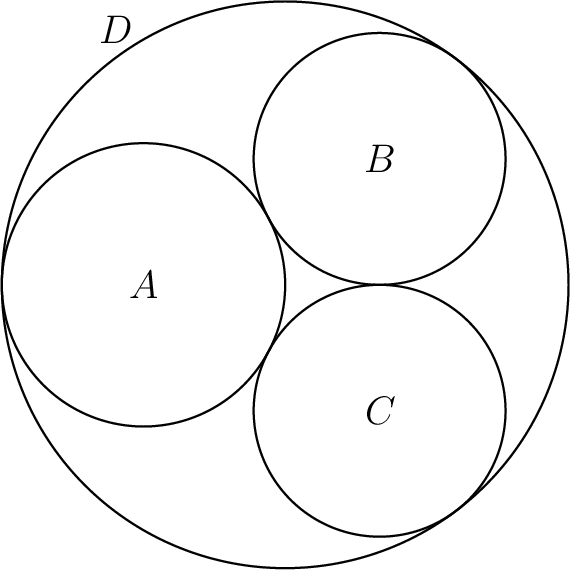
Circles and are externally tangent to each other, and internally tangent to circle . Circles and are congruent. Circle has radius and passes through the center of . What is the radius of circle ?
- A)
- B)
- C)
- D)
- E)
Answer
D
Key insight
Circle D has radius 2; placing B's center at (x, r), the two tangency equations give x = 3r - 2 and 9r^2 = 8r.
Solution
Circle is internally tangent to and passes through 's center, so a diameter of lies along a radius of : circle has radius .
Place 's center at the origin and 's center at . By the symmetry of and , their centers are and , where is the unknown radius; the two circles then touch each other automatically, since their centers are apart.
Two tangency conditions remain.
Circle inside : , so
Circle touching externally: , so
Substitute the first into the second: , giving . Then
Since , . (Then , consistent with .)
The answer is .
Why this works
Tangent circles are entirely described by their centers and radii: external tangency means center distance equals the sum of the radii, internal tangency means the difference. Choosing coordinates that respect the symmetry (the -axis through the centers of and ) leaves two unknowns and two distance equations, and subtracting them removes the squares.
Alternative approach
Descartes' circle theorem with curvatures (enclosing), , : . Expanding, , so and .
The trap
Forgetting that internal tangency means the center distance is 2 - r (not 2 + r), or taking the radius of D to be 1.
Common mistakes
- Forgetting that internal tangency means the center distance is 2 - r (not 2 + r), or taking the radius of D to be 1.
- Squaring an equation like without discarding the extraneous root, or an arithmetic slip in expanding .
Techniques
Add construction lines/points (drop altitudes, extend segments, connect centers) · Place the figure on coordinates and compute