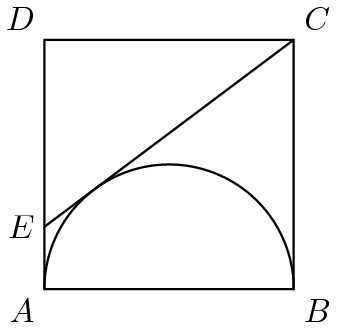
Square has side length . A semicircle with diameter is constructed inside the square, and the tangent to the semicircle from intersects side at . What is the length of ?
- A)
- B)
- C)
- D)
- E)
Answer
D
Key insight
Sides BC and AD are tangents too, so CE = 2 + x and DE = 2 - x; the Pythagorean theorem in triangle CDE gives x = 1/2.
Solution
Let be the point where touches the semicircle. Because and are perpendicular to the diameter at its endpoints, they are tangent to the semicircle at and .
Equal tangents from an external point:
- From : .
- From : . Call this length .
Then , while along the side .
Apply the Pythagorean theorem to right triangle (right angle at ):
Expanding, , so and .
Therefore . (Check: , , is a scaled -- triangle.)
The answer is .
Why this works
Whenever a tangent line meets other tangent lines, mark the tangency points and label equal tangent segments; that converts the circle into pure length bookkeeping. Here the square's sides are hidden tangents, which is why the unknown appears both along and along and a single right triangle finishes the problem.
Alternative approach
Coordinates: , , , center , radius . A line through with slope is ; its distance from is , so and . At the line has , so and .
The trap
Not recognizing that B and A are tangency points, so the equal-tangent lengths CB = CF and AE = EF go unused.
Common mistakes
- Not recognizing that B and A are tangency points, so the equal-tangent lengths CB = CF and AE = EF go unused.
- Writing instead of in the Pythagorean equation.
Techniques
Add construction lines/points (drop altitudes, extend segments, connect centers) · Set up the equation/formula and compute; no special trick needed