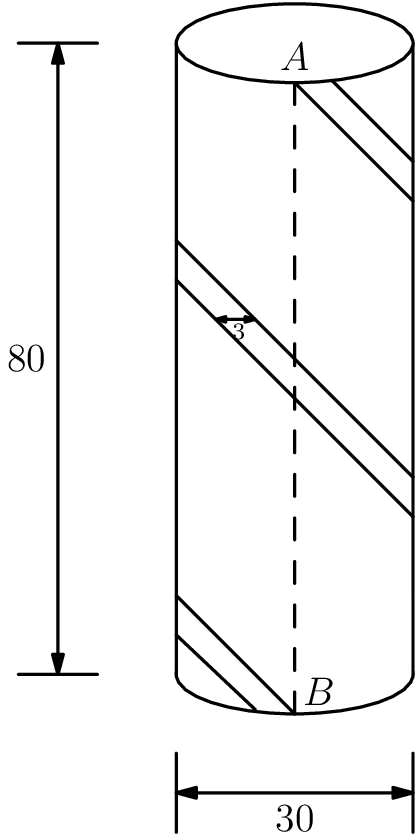
A white cylindrical silo has a diameter of 30 feet and a height of 80 feet. A red stripe with a horizontal width of 3 feet is painted on the silo, as shown, making two complete revolutions around it. What is the area of the stripe in square feet?
- A)
- B)
- C)
- D)
- E)
Answer
C
Key insight
Unroll the silo's surface into a rectangle; the stripe becomes parallelograms of horizontal width 3 whose heights total 80, so the area is 3 times 80.
Solution
Cut the silo's curved surface along a vertical line and flatten it. The surface becomes a rectangle feet wide and feet tall, and distances along the surface are unchanged, so the stripe's area is preserved.
In the flattened picture the stripe is a slanted band whose horizontal cross-section at every height is a segment of length . Each revolution of the stripe is a parallelogram with horizontal base and vertical height (two revolutions span the -foot height). The area of a parallelogram is base times perpendicular height, so each piece has area , and the two pieces together have area
Equivalently, sweeping a horizontal segment of length through a vertical distance of covers area regardless of how the band slants.
The answer is .
Why this works
A cylinder is developable: unrolling it to a flat rectangle preserves lengths and areas, converting a 3-D surface problem into plane geometry. Once flat, a band with constant horizontal width has area (width) (total vertical extent), a Cavalieri-style fact that makes the slant, the diameter, and the number of turns irrelevant. When a problem gives data that cancels, that is often the intended lesson.
The trap
Bringing the circumference 30 pi or the slant of the stripe into the computation; the number of revolutions and the diameter are irrelevant.
Common mistakes
- Bringing the circumference 30 pi or the slant of the stripe into the computation; the number of revolutions and the diameter are irrelevant.
- Using the stripe's slanted length as the parallelogram's height, or measuring the width perpendicular to the stripe instead of horizontally.
Techniques
Cut the figure into known shapes (triangles, rectangles, sectors)