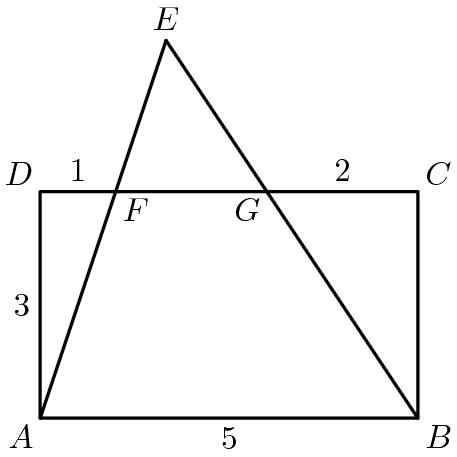
In rectangle and . Points and are on so that and . Lines and intersect at . Find the area of .
- A)
- B)
- C)
- D)
- E)
Answer
D
Key insight
FG = 2 is parallel to AB = 5, so triangle EFG is a 2/5 copy of EAB; heights differ by 3, so the height is 5.
Solution
Since , the segment has length . Because , triangles and are similar (equal corresponding angles), with ratio .
Let be the distance from to line . The distance from to line is then , and the similarity ratio applies to these heights:
Therefore
The answer is .
Why this works
A line parallel to one side of a triangle cuts off a similar triangle, and similar triangles have all linear measurements (including altitudes) in the same ratio. The rectangle's height is the difference of the two altitudes, which pins down the scale. Whenever two lines cross a pair of parallels, look for the small-triangle-inside-big-triangle configuration.
Alternative approach
Coordinates with , , , : line is and line is . Solving, , , so the height is and the area is .
The trap
Using DF = 1 and GC = 2 as if FG were 3 (it is 5 - 1 - 2 = 2), or adding the trapezoid's area to the wrong small triangle.
Common mistakes
- Using and as if were (it is ), or adding the trapezoid's area to the wrong small triangle.
- Setting the height ratio as (treating the rectangle's height as the small triangle's altitude), which gives and area .
Techniques
Set up the equation/formula and compute; no special trick needed