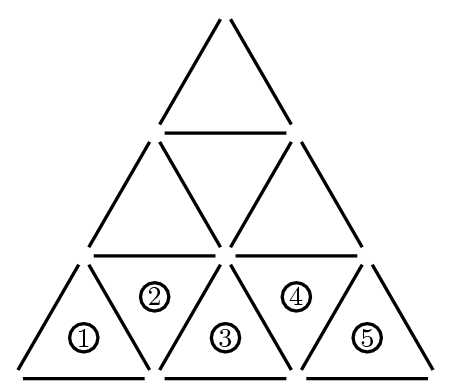
A large equilateral triangle is constructed by using toothpicks to create rows of small equilateral triangles. For example, in the figure, we have rows of small congruent equilateral triangles, with small triangles in the base row. How many toothpicks would be needed to construct a large equilateral triangle if the base row of the triangle consists of small equilateral triangles?
- A)
- B)
- C)
- D)
- E)
Answer
C
Key insight
Every toothpick is a side of exactly one upward-pointing small triangle, and there are 1 + 2 + ... + 1002 of those, so multiply that sum by 3.
Solution
Row from the top contains small triangles: of them point up and point down. A base row of triangles means there are rows.
Look only at the upward-pointing triangles. Each toothpick in the figure is a side of exactly one of them: the horizontal toothpicks are the bottoms of upward triangles, and the slanted toothpicks are their left or right sides. (A downward triangle borrows all three of its sides from neighboring upward triangles.) So no toothpick is counted twice if we count three per upward triangle.
Number of upward triangles: .
Toothpicks: .
Check on the given figure ( rows): toothpicks, which matches a direct count.
The answer is .
Why this works
When objects are shared among several shapes, find a family of shapes that partitions them: here each edge belongs to exactly one upward triangle, so counting is a clean multiplication. Verifying the formula on the small pictured case guards against the two classic slips (miscounting rows, or double counting interior edges).
Alternative approach
Small cases: base rows of triangles need toothpicks, i.e. for rows. With this is . Even without finishing the multiplication, the result ends in , and only choice (C) does.
The trap
Using 2003 as the number of rows instead of the number of triangles in the base row, which yields 6,021,018, choice (E).
Common mistakes
- Using 2003 as the number of rows instead of the number of triangles in the base row, which yields 6,021,018, choice (E).
- Multiplying the total number of small triangles by , which counts every interior toothpick twice.
Techniques
Map the objects to something easier to count · Compute small cases, spot the pattern, generalize