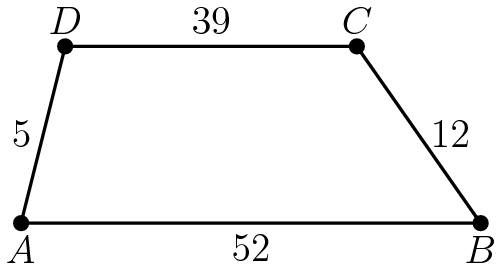
In trapezoid with bases and , we have , , , and . The area of is
- A)
- B)
- C)
- D)
- E)
Answer
C
Key insight
Slide the two legs together: the legs 5 and 12 with base 52 - 39 = 13 form a 5-12-13 right triangle, whose altitude 60/13 is the trapezoid's height.
Solution
Through draw the segment parallel to , meeting at . Then is a parallelogram, so and . The leftover piece is triangle with
Since , this triangle is right-angled at , and its area is .
The height of the trapezoid equals the altitude of this triangle onto its hypotenuse (which lies along ):
Now apply the trapezoid area formula:
The answer is .
Why this works
A trapezoid is a parallelogram plus a triangle: translating one leg across to the other end of the long base isolates a triangle whose sides are the two legs and the difference of the bases. Here that triangle happens to be --, so the height falls out without any trigonometry. The moment you see legs , and base difference , suspect a right triangle.
Alternative approach
Extend the legs to meet at a point above . Triangles and are similar with ratio , so and , making a -- right triangle (a scaled --). Then .
The trap
Treating the trapezoid as if the leg 12 or 5 were the height, giving 546 or 227.5, instead of finding the true height 60/13.
Common mistakes
- Treating the trapezoid as if the leg 12 or 5 were the height, giving 546 or 227.5, instead of finding the true height 60/13.
- Computing and multiplying by the triangle's area or by , confusing the triangle's dimensions with the trapezoid's height.
Techniques
Add construction lines/points (drop altitudes, extend segments, connect centers) · Cut the figure into known shapes (triangles, rectangles, sectors)