2026 AMC 10A Problem 21
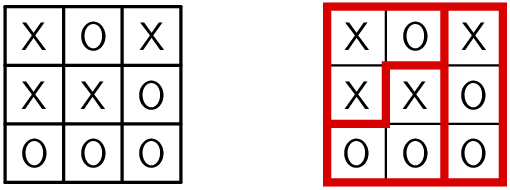
Gerry is playing the Triples Game. Her task is to partition the 3 × 3 grid of squares shown on the left into three sections, each containing three adjoining squares. (Three squares are adjoining if each shares an edge with at least one of the other two.) One point will be awarded for each section containing more X’s than O’s. Shown on the right is a sample partition that will earn one point in total. A partition that earns two or more points will win the game. What fraction of the possible partitions of this particular grid will result in a win for Gerry?
Show solution without answering
Key insight
Two scoring sections need all four X's, two in each, so the third section is all O's. Only two all-O sections exist; count the partitions around each.
Solution
Here is the grid from the left picture. Name each square by its row and column, for example "top-left" or "middle-right".
| left | middle | right | |
|---|---|---|---|
| top | X | O | X |
| middle | X | X | O |
| bottom | O | O | O |
There are X's and O's. We need two counts: how many partitions there are in total, and how many of them win.
Part 1: there are 10 partitions.
- Two shapes of piece. Three adjoining squares form either a straight line of three or an L (a block with one square missing).
- Some piece is a whole edge of the grid. The grid has corner squares. An L fits inside a block, and each of the four blocks of the grid contains exactly one corner square, so an L holds at most one corner. A straight piece through the middle row or middle column holds no corners. Three pieces must hold all four corners, so some piece holds two corners. That piece must be a full edge: the top row, the bottom row, the left column or the right column.
- Each edge piece leaves 3 ways. Say the top row is a piece. What is left is a block of two rows of three. Look at the piece containing the block's top-left square. It cannot be a straight piece standing up (the block is only two squares tall), so it is either the block's whole top row (and the other row is the last piece), or one of the three L's that fit in the block's left corner. Two of those L's leave a connected L behind; the third cuts off a single square, which cannot be a piece. So the block splits in exactly ways. Turning the picture shows the same holds for each of the four edges.
4. Count without double counting. Four edges with ways each gives . But two partitions contain two edge pieces and were counted twice: the three rows (it has both the top and the bottom row) and the three columns. No partition has an edge row and an edge column together, since they would share a corner square. So the total is
Part 2: exactly 4 partitions win.
- What earns a point. A section has three squares, so "more X's than O's" means at least X's.
- A win needs an all-O section. Two points need two sections with at least X's each, which uses at least X's. There are only X's, so the two scoring sections have exactly X's each, and the third section has no X at all.
7. Find the all-O sections. The O's are top-middle, middle-right and the whole bottom row.
- Top-middle is boxed in by X's on its left, right and below, so it cannot join other O's.
- Middle-right touches only one other O, bottom-right.
So there are just two all-O pieces: the bottom row, and the L made of middle-right, bottom-right and bottom-middle.
8. Case A: the bottom row is a piece. The top two rows split in ways (step 3):
- top row (X O X) and middle row (X X O): points, a win;
- {top-left, top-middle, middle-left} (X O X) and {top-right, middle-middle, middle-right} (X X O): points, a win;
- {top-left, middle-left, middle-middle} (X X X) and {top-middle, top-right, middle-right} (O X O): only point.
That is wins.
9. Case B: the L {middle-right, bottom-right, bottom-middle} is a piece. The squares left are the top row, middle-left, middle-middle and bottom-left. Top-right now has only one free neighbor, top-middle, so its piece is top-right, top-middle and one more square: top-left or middle-middle.
- top row (X O X) and {middle-left, middle-middle, bottom-left} (X X O): a win;
- {top-right, top-middle, middle-middle} (X O X) and the left column (X X O): a win.
That is more wins.
10. The fraction. winning partitions out of :
The answer is .
Why this works
When a win needs a lot of something scarce, count that resource first. Here two points need four X's, which forces a -- split and leaves only two cases to check. For the total, the four-corners argument (three pieces cannot cover four corners unless one piece takes two) guarantees that the list of partitions is complete, which is the hardest part of any "list them all" problem.
Alternative approach
Score all partitions directly, grouped by an edge piece they contain. (The sample partition in the problem is the fifth row of the table.)
| partition | points |
|---|---|
| three rows | (win) |
| top row; {middle-left, middle-middle, bottom-left}; {middle-right, bottom-middle, bottom-right} | (win) |
| top row; {middle-left, bottom-left, bottom-middle}; {middle-middle, middle-right, bottom-right} | |
| bottom row; {top-left, top-middle, middle-left}; {top-right, middle-middle, middle-right} | (win) |
| right column; {top-left, top-middle, middle-left}; {middle-middle, bottom-left, bottom-middle} | |
| right column; {top-left, top-middle, middle-middle}; {middle-left, bottom-left, bottom-middle} | |
| bottom row; {top-left, middle-left, middle-middle}; {top-middle, top-right, middle-right} | |
| left column; {top-middle, top-right, middle-middle}; {middle-right, bottom-middle, bottom-right} | (win) |
| left column; {top-middle, top-right, middle-right}; {middle-middle, bottom-middle, bottom-right} | |
| three columns |
Four of the ten win, so the fraction is . This takes longer than the case argument, but it doubles as a check that the list really has entries.
Concise solution
A shorter write-up, the way contest solutions are usually written. It may take a different route from the solution above.
Total. Each piece is a straight tromino or an L. An L lies in a block and so contains at most one corner of the grid, and a middle row or column contains none. Since three pieces cover four corners, some piece is a full edge row or column. Removing it leaves a block, which has tilings. Four edges give , and the all-rows and all-columns tilings are each counted twice, so there are partitions.
Wins. A section scores when it has at least X's. With only X's, two scoring sections need a -- split, so the third section is all O's. The only all-O trominoes are the bottom row and the L {middle-right, bottom-right, bottom-middle}.
- Bottom row taken: of the tilings of the top two rows, the two-rows tiling and the tiling {top-left, top-middle, middle-left} + {top-right, middle-middle, middle-right} win; the third gives an XXX piece and an OXO piece and scores .
- The L taken: top-right must pair with top-middle plus top-left or middle-middle, giving tilings, and both split the X's -.
So of the partitions win, and the fraction is .
The answer is .
Review in the AoPS books
- Introduction to Counting & Probability, Chapter 5: More With Combinations (§5.2)
- Introduction to Counting & Probability, Chapter 1: Counting Is Arithmetic
- Introduction to Counting & Probability, Chapter 7: Introduction to Probability
- Prealgebra, Chapter 15: Problem-Solving Strategies (§15.2)
Similar problems
Problem © Mathematical Association of America (MAA), American Mathematics Competitions. Reproduced for non-commercial educational use. Solution and commentary are original to this site.