2026 AMC 10A Problem 22
An engineer is designing a closely packed field of wind turbines for electricity production. Each turbine, whose center is marked by a labeled dot in the figure, occupies one of congruent elliptical regions. Turbines in the same row have centers that are units apart, and turbines in the same column have centers that are units apart, as shown in the figure below
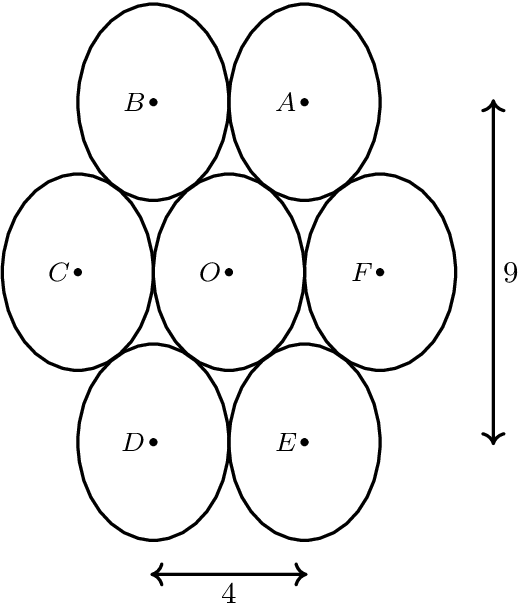
The major axis of each ellipse is , where and are positive integers and is not divisible by the square of any prime. What is ?
Show solution without answering
Key insight
Half a turn about the point halfway between two centers swaps those two equal ellipses, so if they touch, they touch exactly at that halfway point.
Solution
Each touching pair of ellipses gives one equation. The trick is knowing where two equal ellipses touch, and symmetry answers that.
1. Put the centers on coordinates. The picture has three rows: on top; in the middle; at the bottom. Put at .
- Same row, apart: and .
- The top and bottom rows sit halfway between the middle-row centers, so and have , and and have .
- and are in the same column and apart, but they are two rows apart. So neighboring rows are apart, and
2. The ellipse around . The ellipses all have the same size and stand upright, taller than they are wide. Write 's ellipse as
where is half its width and is half its height. Every other ellipse is this one slid over to a new center.
3. Where two equal ellipses touch. Take two of the ellipses, say around and , and let be the point halfway between their centers.
- Spin the whole picture half a turn around . The center lands on and lands on . An ellipse looks exactly the same after half a turn around its own center, so the spin swaps the two ellipses.
- Suppose the two ellipses share a point . After the spin, lands on a point on the opposite side of , and is also shared. An ellipse has no dents, so the straight segment from to lies inside both ellipses, and that segment passes through . So whenever the ellipses meet at all, is inside both of them.
- "Closely packed" means neighbors just touch without overlapping. So must sit exactly on the edge of each ellipse: the touching point is the halfway point.
(Two equal coins touch halfway between their centers for the same reason.)
- and give the width. The halfway point of and is . It lies on 's ellipse, so and . (That makes sense: the ellipses are wide, and centers in a row are apart.)
5. and give the height. The halfway point of and is . It lies on 's ellipse:
So .
- The major axis. The height is bigger than the width , so the major (long) axis is the vertical one, of length . Here and , and has no square factor.
- Check the other neighbors. Every other touching pair is a copy of one of these two: and are apart in a row like and , and pairs such as and or and are across and up or down, like and . So one ellipse size makes all the neighbors touch.
So .
The answer is .
Why this works
Two equal ellipses facing the same way are swapped by a half turn around the point halfway between their centers. That symmetry pins the touching point to the halfway point, so each touching pair gives one easy equation: "this point is on the ellipse". The same idea works for any two equal shapes that look the same after a half turn, such as circles, squares and rectangles.
Alternative approach
Squash the picture until the ellipses become circles.
1. Shrink every height in the picture by the same factor, chosen so that each ellipse becomes a circle of radius (its half-width). Shapes that just touch still just touch after the squash.
2. Circles of radius that touch have centers apart. The row of is unchanged, and , and the squashed now form an equilateral triangle of side : the familiar honeycomb pattern of coins.
3. The height of an equilateral triangle with side is . So squashing changed the row spacing from to , a factor of .
4. The circle's height was squashed from the ellipse's height by that same factor, so the ellipse's height is
The major axis is , and .
Concise solution
A shorter write-up, the way contest solutions are usually written. It may take a different route from the solution above.
Place , ; adjacent rows are apart (the spans two rows), so . Let each ellipse be a copy of slid to its own center.
Two congruent, equally oriented ellipses are swapped by the half turn about the midpoint of their centers. If they share a point , they also share its image , and since an ellipse is convex (it has no dents) the segment , which passes through , lies in both. So two such ellipses that touch without overlapping touch exactly at .
Tangency of and at gives . Tangency of and at gives
Since , the major axis is , so and .
The answer is .
Review in the AoPS books
- Introduction to Geometry, Chapter 17: Analytic Geometry
- Introduction to Geometry, Chapter 16: The More Things Change. . . (§16.1, §16.2, §16.3, §16.4)
- Introduction to Algebra, Chapter 22: Special Manipulations (§22.3)
- Introduction to Algebra, Chapter 8: Graphing Lines
Similar problems
Problem © Mathematical Association of America (MAA), American Mathematics Competitions. Reproduced for non-commercial educational use. Solution and commentary are original to this site.