2026 AMC 10A Problem 19
Three x x cubes sit on a table so that two of the cubes share a face, and a face of the third cube is centered along a shared edge of the other two cubes, as (not) shown.
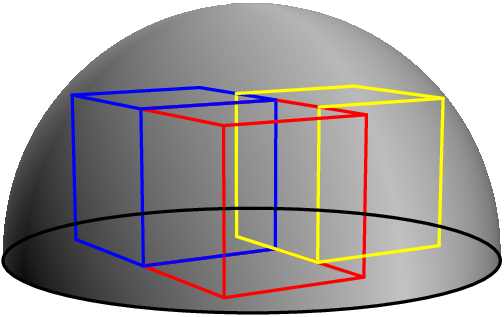
A hemispherical cover is placed over the cubes so that its circumference rests on the table and the cubes are under the cover. What is the least possible value of the radius of the cover?
Show solution without answering
Key insight
The cover's center sits on the table and the top corners are hardest to reach. Find the smallest circle around the footprint, then add the height 2 by Pythagoras.
Solution
Look down at the table from above. The problem becomes a flat question about a circle drawn on the table, plus one use of Pythagoras for the height of the cubes.
1. Draw the footprint. Put coordinates on the table.
- The two joined cubes stand side by side and together cover a rectangle: from to and from to . Their shared face stands above the segment .
- That shared face has two vertical edges, standing above the points and . The third cube's face is centered on the edge above . The face is wide, so it runs from to , and the third cube sticks out beyond the pair: from to and from to .
From above, the cubes form a T shape: a rectangle with a square attached to the middle of one long side.
- What "under the cover" means. The cover is half of a ball with radius . Its rim rests on the table, so its center is a point on the table. A point is under the cover exactly when its distance from is at most .
3. Only the top corners matter. The point of a box farthest from is always one of its corners. A corner on top of a cube, at height , stands directly above a corner of the footprint. The flat distance and the vertical edge of length meet at a right angle, so by Pythagoras that top corner is at distance from . The bottom corner at is closer. So we need
In other words: find the smallest circle on the table that surrounds the whole T (call its radius ), and then .
- Use the symmetry. The T is symmetric about the -axis, so try a center on that line, . (Step 8 checks that moving off the line cannot help.)
5. The corners that pull hardest. The far corners of the T are the bottom corners and the top corners . Their squared distances from are
Moving the center up brings the top corners closer but pushes the bottom corners away, and moving it down does the opposite. The best spot is where the two are equal:
6. The flat radius. With :
Check with a top corner: . The same, as planned.
- The other corners are inside. The corners are at squared distance , and the inner corners are at . Both are less than .
8. Moving off the line does not help. Suppose the center moves to the right of the -axis (or stays on it). Then it is at least as far sideways from the two left corners and as before.
- If it also moves up, it gets farther from vertically too, so that corner ends up beyond .
- If it moves down, it gets farther from , so that corner ends up beyond .
- If it only moves sideways, both left corners get farther.
Moving to the left fails in the same way, using the right corners and . So is the best center, and is the smallest possible.
9. Add the height.
The answer is .
Why this works
A hemisphere resting on a table has its center on the table, so Pythagoras splits every distance into a flat part and a height part. Since every top corner has the same height, the 3D question becomes "find the smallest circle around the footprint". The smallest circle is decided by the points that are farthest out; here a balance between the bottom corners and the top corners. Symmetry tells you which line to search along, and setting two distances equal gives the exact spot.
Concise solution
A shorter write-up, the way contest solutions are usually written. It may take a different route from the solution above.
Place the footprint on coordinates: the joined pair covers , and the third cube, whose face is centered on the vertical edge above , covers .
The cover's center lies on the table. The farthest point of each cube from is a top corner, at height above a footprint corner , so , where is the radius of the smallest circle on the table containing all footprint corners.
By symmetry take . The binding corners are and ; equating
gives and . The corners and are closer. Any move off the axis increases the distance to one of or one of , so this circle is smallest.
Then and .
The answer is .
Review in the AoPS books
- Introduction to Geometry, Chapter 14: Three-Dimensional Geometry
- Introduction to Geometry, Chapter 10: Geometric Inequalities
- Introduction to Geometry, Chapter 11: Circles
- Introduction to Geometry, Chapter 17: Analytic Geometry (§17.4, §17.6)
Similar problems
Problem © Mathematical Association of America (MAA), American Mathematics Competitions. Reproduced for non-commercial educational use. Solution and commentary are original to this site.