2026 AMC 10A Problem 17
For each edge of a regular hexagon with side length , a square is constructed inside the hexagon with that edge as one of its sides. The region interior to all six squares is the interior of a smaller hexagon, shown shaded in the figure below. 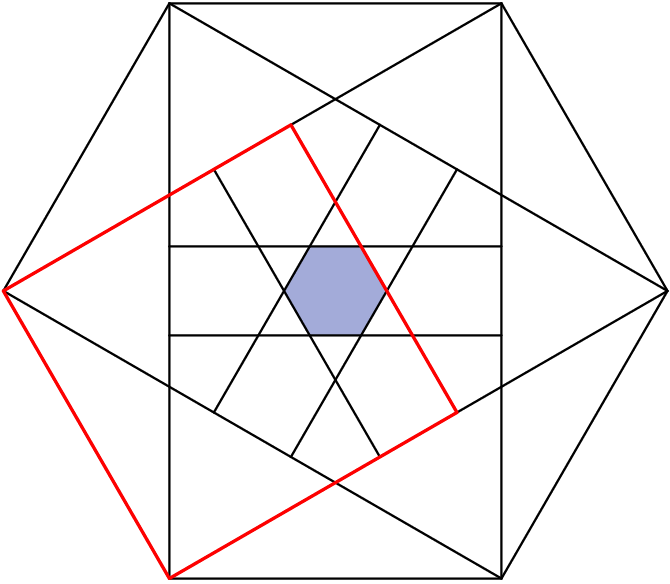 The area of the smaller hexagon can be expressed in the form , where and are all positive integers, and are relatively prime, and is not divisible by the square of any prime. What is ?
Show solution without answering
Key insight
Each square reaches 1 unit inward, but the center is only √3/2 inward, so the small hexagon's center-to-side distance is 1 − √3/2.
Solution
Everything in the picture is arranged evenly around the center of the big hexagon, so measure distances from that center. Call the center .
1. How far is from each side. The big hexagon is made of equilateral triangles with side that meet at . The distance from to a side is the height of one of these triangles. Half of an equilateral triangle with side is a -- triangle with hypotenuse and short leg , so the height is
2. How far each square reaches. Turn the picture so that one side of the big hexagon is at the bottom. The square on that side goes straight up a distance . The center is only above the bottom side, so the top edge of this square is above by
- Pair it with the opposite square. The top side of the big hexagon also has a square, hanging straight down, and by the same reasoning its bottom edge is a distance below . A point inside both squares must be below the first square's top edge and above the second square's bottom edge. So it lies in a narrow band between two parallel lines, each a distance from . (In the figure, these are the two horizontal lines running along the top and the bottom of the shaded region.)
- All three pairs. The hexagon has three pairs of opposite sides, each pair turned from the last. Each pair gives a band like the one in Step 3. The region inside all three bands is a regular hexagon centered at , and the distance from to each of its sides is . (This center-to-side distance of a regular polygon is called its apothem.) The other two sides of each square are away from on either side, far outside this tiny region, so they do not cut into it. This small hexagon is the shaded one.
5. Area of a regular hexagon from its apothem. Split the small hexagon into equilateral triangles meeting at . Each has height . In an equilateral triangle the height is times the side, so each side is . One triangle has area
and six of them give
6. Compute . Square like any difference:
7. The area.
As a check, this is about , a tiny area, just like the small shaded region in the picture.
8. Read off the numbers. , , , . Here and are relatively prime and is not divisible by any square, so the form is correct, and
The answer is .
Why this works
When a figure has a center and everything is spread evenly around it, measure from the center. Each square only matters through one number, how far its far edge reaches past the center, and that single distance describes the whole shaded hexagon. The region inside several strips between parallel lines is a polygon, and when the strips are evenly turned, the polygon is regular. Finally, any regular polygon splits into identical triangles at its center, which gives its area from either the side or the apothem.
Alternative approach
Find the side length of the small hexagon first and use the usual formula for a regular hexagon with side .
From Steps 1 to 4, the small hexagon's apothem is , and the apothem of a regular hexagon is times its side. So
Then
the same area, so .
Concise solution
A shorter write-up, the way contest solutions are usually written. It may take a different route from the solution above.
Let be the center. Each side of the big hexagon is from , and each inward square has depth , so its far edge lies on the other side of at distance . The squares on opposite sides therefore overlap in a band of half-width about , and the three bands meet in a regular hexagon with apothem (the squares' lateral sides are from and do not interfere). A regular hexagon with apothem has area , so the area is
Thus .
The answer is .
Review in the AoPS books
- Introduction to Geometry, Chapter 8: Quadrilaterals
- Introduction to Geometry, Chapter 4: Perimeter and Area (§4.2)
- Introduction to Algebra, Chapter 22: Special Manipulations (§22.3)
- Introduction to Geometry, Chapter 9: Polygons (§9.3)
Similar problems
Problem © Mathematical Association of America (MAA), American Mathematics Competitions. Reproduced for non-commercial educational use. Solution and commentary are original to this site.